

War in Iran: Live Market Tracker — Oil, Gold, Saudi & US Stocks, and More
SAUDI ARAMCO 2222.SA | 0.00 | |
SPDR Gold GLD | 0.00 | |
S&P 500 index SPX | 0.00 | |
Tadawul All Shares Index TASI.SA | 0.00 | |
CBOE Volatility Index | 0.00 |
The escalating military conflict between the United States, Israel, and Iran is sending shockwaves through global financial markets.
Energy prices, safe-haven assets, and regional equities are all reacting in real time as investors assess the risk of prolonged supply disruptions — particularly through the Strait of Hormuz, a critical chokepoint for roughly 20% of the world's seaborne oil supply.
Below, we track key market movements and their implications for investors in Saudi and U.S. equities.
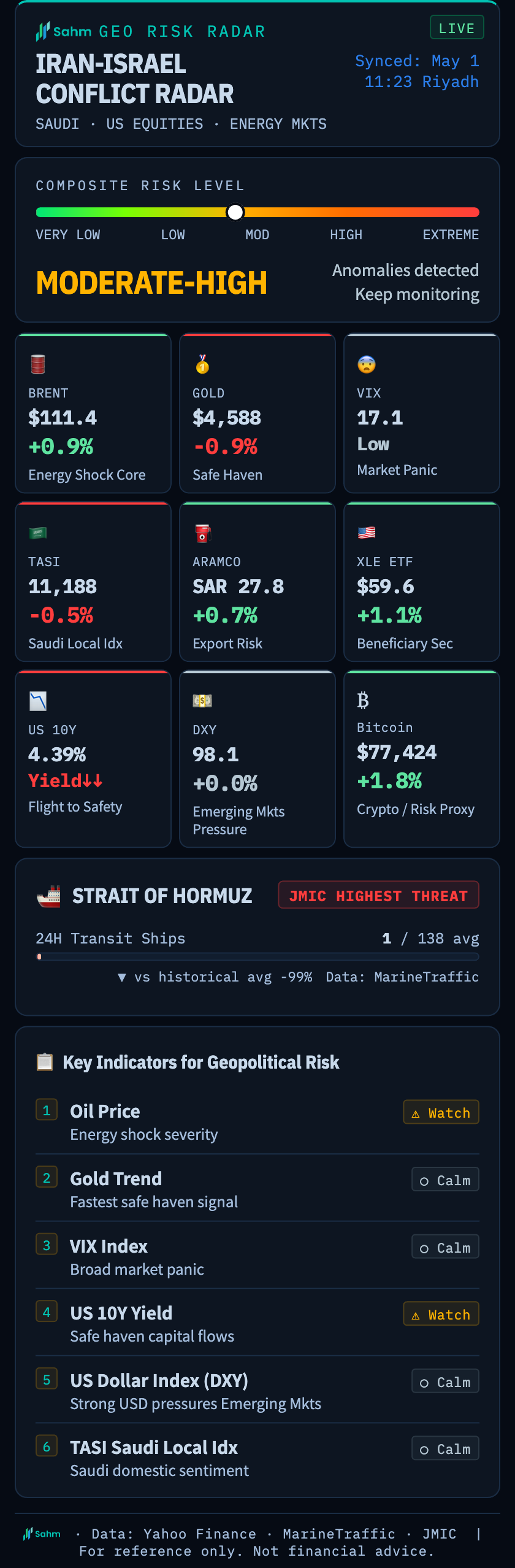
This article is continuously updated. Scroll down for the latest developments — newest entries appear at the top.
🕐 Just in
WTI crude is trading at $105.65 (+0.55%) after Brent previously surged into the $120–$126 range. Reports attribute the rally to the U.S.-Iran deadlock, Iranian port blockades, and continued shipping delays in the Strait of Hormuz.
🕐 Earlier Today
Surging oil prices have pushed U.S. gasoline costs near or above recent highs in several regions. Markets remain concerned that high energy costs will continue to impact aviation, logistics, and daily consumption, reinforcing inflationary pressures.
🕐 Earlier Today
Following a "final warning," Japan intervened in the currency market, sparking the yen's largest gain in nearly two years. The subsequent drop in USD/JPY highlights increased short-term volatility driven by policy intervention rather than fundamental shifts.
🕐 Earlier Today
EUR/USD is trading near 1.17, remaining flat to slightly higher. The Euro previously touched 1.1720 as traders adjusted positions ahead of the ECB interest rate decision, while the U.S. Dollar was constrained by policy divergence and safe-haven sentiment.
🕐 Earlier Today
Data shows a decline in 5-year and 10-year U.S. Treasury yields, reflecting safe-haven buying and a reassessment of future policy paths. Simultaneously, UK Gilts strengthened as rate hike expectations cooled following the Bank of England's decision, signaling a global linkage among interest-rate-sensitive assets.
🕐 Earlier Today
U.S. equity markets recorded their strongest monthly performance since 2020 at the end of April, supported by robust GDP data and AI-related earnings. However, Nasdaq futures are currently under pressure due to high oil prices and prevailing policy uncertainty.
🕐 Earlier Today
Bitcoin is trading at $77,156.34 (+1.11%), indicating that capital has not fully exited high-volatility assets despite macro and geopolitical disruptions. Its resilience mirrors the strength in U.S. equities and the lack of a significant unilateral surge in the U.S. Dollar.
Iran-Israel Conflict: Assets to Watch
🛢 Oil & Energy — Benefits from conflict escalation
| Ticker | What & Why |
|---|---|
| Spdr Select Fund-Energy Select Sector(XLE.US) | Energy sector ETF — highest liquidity, tracks US oil majors |
| United Sts Brent Oil Fd Lp Unit(BNO.US) | Brent crude ETF — direct exposure to Middle East oil price |
| Spdr S&P Oil & Gas Explor & Product(XOP.US) | Oil & gas exploration ETF — higher volatility, higher upside |
| Proshares Trust Ii Ultra Bloomberg Crude Oil(Post Rev Splt)(UCO.US) | 2× leveraged crude oil — short-term traders only |
| Exxon Mobil Corporation(XOM.US) | ExxonMobil stock — world's largest listed oil company |
| Chevron Corporation(CVX.US) | Chevron stock — major Middle East operations, strong dividend |
Saudi Market (Tadawul All Shares Index(TASI.SA)) — Monitor closely
| Ticker | What & Why |
|---|---|
| Saudi Arabian Oil Co.(2222.SA) | Saudi Aramco — core Saudi play, moves with oil prices |
| National Shipping Company of Saudi Arabia(4030.SA) | Bahri Shipping — tanker rates spike when Hormuz is disrupted |
| Saudi Arabian Mining Co.(1211.SA) | Ma'aden Mining — Saudi's only gold miner, safe-haven proxy on Tadawul |
| Saudi Basic Industries Corp.(2010.SA) | SABIC — key TASI index weight, watch energy cost impact |
| Al Rajhi Bank(1120.SA) | Al Rajhi Bank — largest Saudi bank, broad market sentiment indicator |
🥇 Safe Haven & Gold — Rises when fear spikes
| Ticker | What & Why |
|---|---|
| SPDR Gold(GLD.US) | SPDR Gold ETF — world's most liquid gold fund, first to react |
| Gold Trust Ishares(IAU.US) | iShares Gold ETF — lower fees than GLD, better for longer holds |
| VanEck Vectors Gold Miners ETF(GDX.US) | Gold Miners ETF — moves 2–3× gold price, higher risk/reward |
| Ultrashort Gold Proshares(GLL.US) | 2× inverse gold ETF — use when conflict eases and fear fades |
🛡 Defense & Aerospace — Benefits from prolonged conflict
| Ticker | What & Why |
|---|---|
| iShares U.S. Aerospace & Defense ETF(ITA.US) | Aerospace & Defense ETF — holds RTX, LMT, NOC, GD |
| RAYTHEON TECHNOLOGIES CORPORATION(RTX.US) | Raytheon — makes Patriot missile systems used in Israel's defense |
| Lockheed Martin Corporation(LMT.US) | Lockheed Martin — F-35 and missiles supplied to Israel and Gulf allies |
| Northrop Grumman Corp.(NOC.US) | Northrop Grumman — stealth aircraft, drones, missile defense systems |
📉 Bearish / Inverse Plays — Use when conflict de-escalates
| Ticker | What & Why |
|---|---|
| Ultrashort DJ-UBS Crude Oil Proshares(SCO.US) | 2× inverse crude oil ETF — profits when oil drops on ceasefire news |
| Ultrashort Oil & Gas Proshares(DUG.US) | 2× inverse energy sector ETF — use when oil rally overextends |
| U.S. Global Jets ETF(JETS.US) | Airlines ETF — high oil prices crush margins |
| iShares MSCI South Korea ETF(EWY.US) | South Korea ETF — imports nearly all oil, hardest hit in Asia |
| Ishares Msci Japan Index Fund(EWJ.US) | Japan ETF — heavy energy importer, conflict weakens yen and growth |
₿ Bitcoin — Unconventional Safe Haven (Handle with Care)
⚠️ Bitcoin's correlation to geopolitical conflict is inconsistent — it sometimes acts as a safe haven, sometimes as a risk asset. In the current Iran-Israel conflict, BTC rebounded after an initial sell-off, suggesting selective safe-haven demand. Watch with extra caution and smaller position sizes if in trade.
| Ticker | What & Why |
|---|---|
| Shares Bitcoin Trust(IBIT.US) | iShares Bitcoin Trust (BlackRock) — largest spot Bitcoin ETF with $70.6B AUM and the highest liquidity of any Bitcoin ETF, tightest bid-ask spread. Best choice for most investors. |
| Bitwise Bitcoin ETF Trust(BITB.US) | Bitwise Bitcoin ETF — lower expense ratio at 0.20%, good liquidity, smaller but reputable issuer. |
| ProShares UltraShort Bitcoin ETF(SBIT.US) | ProShares 2x Short Bitcoin ETF — inverse Bitcoin play, use when risk-off sentiment causes BTC to sell off alongside equities, short-term traders only |
The above is for informational purposes only and does not constitute investment advice. Leveraged and inverse ETFs are designed for short-term trading only. Past performance does not guarantee future results.
April 30
Brent crude spot surged past $120 per barrel, nearing the $126 threshold—a level not seen since 2022. The spike is driven by the deadlocked negotiations and the ongoing U.S. blockade of Iranian ports. Goldman Sachs estimates that exports through the Strait of Hormuz have collapsed to just 4% of normal levels, as supply shortage fears continue to propel prices upward.
🕐 Earlier Today
As the Iran war enters its third month, global energy supplies are under historic pressure, sparking sharp concerns over stagflation risks. Asian markets reacted negatively: the Nikkei and Hang Seng both dropped approximately 1%, while India’s Sensex plummeted over 800 points, sending the Rupee to a record low.
🕐 Earlier Today
The Federal Reserve held interest rates steady in its latest meeting while issuing a stern warning on inflation. With the market now pricing out near-term rate cuts, the U.S. Dollar strengthened, causing a broad retreat in precious metals. Spot Gold fell 1.4% to $4,528.17/oz, Silver dropped 2.7% to $71.08, and Platinum tumbled 3%.
🕐 Earlier Today
Tech earnings presented a polarized picture. Alphabet Inc. Class A(GOOGL.US)’s sales beat expectations, and overall reports from Microsoft Corporation(MSFT.US) and Amazon.com, Inc.(AMZN.US) remained positive, lifting NASDAQ-100(NDX.US) futures by 0.6% and S&P 500 index(SPX.US) futures by 0.3%. Conversely, Meta Platforms(META.US) shares tanked due to investor anxiety over aggressive spending, highlighting a clear split in market sentiment.
🕐 Earlier Today
Samsung Electronics posted a record quarterly profit, led by a staggering 50-fold increase in semiconductor earnings. This performance underscores the relentless global demand for AI and data centers. However, analysts warned that the chip supply crunch is expected to deteriorate further heading into 2027.
🕐 Earlier Today
Bitcoin saw marginal movement (+0.11%), remaining roughly $17,000 lower than its price a year ago, as cautious sentiment dominates the crypto space. In the forex market, EUR/USD held steady at 1.17 (+0.03%), with the dollar's strength underpinned by the Fed’s hawkish stance.
April 29
Brent Crude oil prices extended their rally to $106.5 (+2%) following news that the U.S. may extend its naval blockade of Iranian ports. Brent crude has now recorded gains in six of the last seven trading sessions, with a cumulative surge of over 40% since the onset of the U.S.-Iran conflict.
🕐 Earlier Today
The UAE announced on April 28 that it will officially exit OPEC and the OPEC+ alliance on May 1. This move is seen as a major blow to the oil-producing group. Analysts warn that the decline in OPEC’s cohesion could lead to significantly higher price volatility in the future.
🕐 Earlier Today
Ship-tracking data confirms that the first LNG and VLCC tankers have successfully transited the Strait of Hormuz for the first time in weeks, heading toward China and Japan. Despite this breakthrough, analysts caution that overall traffic through the waterway remains far below normal levels and risks remain elevated.
🕐 Earlier Today
The U.S. national average for regular gasoline has climbed to $4.18 per gallon, the highest level since April 2022, according to AAA. Negotiations between the U.S. and Iran remain at a standstill, with massive disagreements persisting over control of the Strait of Hormuz and nuclear issues.
🕐 Earlier Today
Technology stocks retreated after the Wall Street Journal reported that OpenAI’s revenue and user growth missed internal expectations. The company's CFO reportedly expressed concerns regarding OpenAI's ability to fulfill its computing power contracts. In response, the NASDAQ(IXIC.US) fell 0.9% and the S&P 500 index(SPX.US) slipped 0.49%.
🕐 Earlier Today
Novo Nordisk A/S Sponsored ADR Class B(NVO.US) shares have surged 16.3% over the past month and 7.6% over the past week, drawing significant market attention. However, the stock remains down 19.5% year-to-date and 34.5% over the past year, as debates continue regarding whether its current valuation is justifiable.
April 28
Brent crude futures rose to approximately $108 per barrel, while WTI broke above $97 as U.S.-Iran peace negotiations remained deadlocked. The ongoing blockade of the Strait of Hormuz has now impacted roughly 20% of global oil and LNG supplies. Analysts warn that WTI could return to levels above $100 if the diplomatic stalemate persists and the regional situation deteriorates further.
🕐 Earlier Today
Bitcoin is trading at $76,645.93, maintaining a gain of roughly 6.5% compared to last week’s opening. Investors have moved to the sidelines ahead of Wednesday's Federal Reserve interest rate decision; the market expects the Fed to issue hawkish signals to counter the inflationary pressure driven by surging energy costs.
🕐 Earlier Today
EUR/USD is at 1.17, pressured by the slow progress of ceasefire talks and deteriorating economic data in Europe. The Eurozone Composite PMI dropped to 48.6, its lowest level since November 2024. This week is critical for forex markets as five major G10 central banks—the BoJ, BoC, Fed, BoE, and ECB—are all scheduled to hold policy meetings.
🕐 Earlier Today
The S&P 500 index(SPX.US) and NASDAQ(IXIC.US) both reached record closes on Monday, finishing at 7,173.91 (+0.12%) and 24,887.10 (+0.20%) respectively. While Nvidia and Alphabet provided broad support, QUALCOMM Incorporated(QCOM.US) shares surged approximately 7% following reports of a partnership with OpenAI to develop an AI-integrated smartphone.
🕐 Earlier Today
The Bank of Japan maintained its policy rate at 0.75% on Tuesday, though the decision saw dissent as three board members proposed an immediate hike. In its economic outlook, the BoJ projected that high oil prices will push 2026 CPI into the 2.5%–3.0% range, while simultaneously lowering its growth forecasts for the Japanese economy.
🕐 Earlier Today
Gold prices fell for a second straight session, weighed down by a strengthening U.S. Dollar and the ambiguous outlook for Middle East peace talks. There is growing concern that prolonged regional tensions and energy-driven inflation will force global central banks to keep monetary policy tight, reducing the non-yielding metal's attractiveness.
April 27
International crude oil prices surged as U.S.-Iran peace negotiations stalled and the blockade of the Strait of Hormuz persisted. Brent crude surpassed $106 per barrel, while WTI rose above $96. Consequently, Goldman Sachs revised its Q4 Brent price forecast upward to $90 per barrel.
🕐 Earlier Today
Stock markets in Japan and South Korea hit all-time highs on Monday, despite ongoing Middle East tensions. Investors appeared to shrug off the diplomatic stalemate between Washington and Tehran, choosing instead to extend the momentum from Wall Street’s strong performance last week.
🕐 Earlier Today
U.S. equity futures edged lower, with the three major indices down between 0.2% and 0.3%. Markets are pivoting focus toward upcoming Big Tech earnings and the Federal Reserve's interest rate decision. Notably, the S&P 500 and Nasdaq have recorded massive gains in April, rising over 9% and 15% respectively.
🕐 Earlier Today
June gold futures fell 2.56% last week to settle at $4,725.40 per ounce. The spike in oil prices has driven up inflation expectations, significantly dampening market hopes for a Fed rate cut. As a result, safe-haven demand for gold is currently being overshadowed by the "higher-for-longer" interest rate narrative.
🕐 Earlier Today
U.S. consumer sentiment hit a record low of 49.8 in April, according to the University of Michigan. One-year inflation expectations jumped from 3.8% to 4.7%—the largest monthly surge since April 2025—underscoring the severe impact of the Iran war on the American public's outlook.
🕐 Earlier Today
Bitcoin reclaimed the $78,000 support level, primarily buoyed by news that Pakistan has lifted the "Red Zone" blockade in Islamabad. While direct talks between the U.S. and Iran were canceled, market participants expect indirect negotiations to continue through intermediaries.
April 25-26
Trump Cancels Pakistan Talks: 'We Have All The Cards, They Have None!'
🕐 Earlier
Iran has proposed a comprehensive plan to manage the Hormuz Strait, covering navigation permits, fee collection, and sovereignty enforcement, according to state media. The plan prioritizes rial settlements, bans Israeli vessels, and requires compensation agreements from adversarial nations. Meanwhile, the US continues its naval blockade, redirecting 37 vessels since April 13.
🕐 Earlier
JPMorgan warns that global oil supply and demand are imbalanced, with idle capacity failing completely. To address this, prices must rise significantly to force reductions in consumption across Europe and the US. Analyst Natasha Kaneva notes that physical constraints require higher prices to balance the market, as supply disruptions have increased and inventories are rapidly depleting, yet Brent futures remain below US$100/barrel.
April 24
WTI crude is currently trading at $95.72, down 0.14% intraday, though it remains on track for a strong weekly performance. Reports from Reuters and CNBC highlight that the stalemate in U.S.-Iran negotiations and the ongoing blockade of the Strait of Hormuz have made energy security the primary variable for global markets.
🕐 Earlier Today
U.S. equities pulled back on Thursday, with the S&P 500 falling approximately 0.4% and the Nasdaq seeing steeper losses. Fading hopes for a swift de-escalation in the Iran conflict, combined with mixed corporate earnings, weighed on sentiment. Having recovered most war-related losses, major indices are proving sensitive to surging oil prices at these elevated levels.
🕐 Earlier Today
EUR/USD is at 1.17, down 0.01%, amid limited volatility. However, the U.S. Dollar is on track for its first weekly gain in three weeks as stalled peace talks and rising Middle Eastern uncertainty drive capital back into safe-haven assets.
🕐 Earlier Today
Bitcoin is trading at $77,950, down 0.42%, signaling a cooling of momentum after breaching the $78,000 mark. While prices hit their highest levels since early February, traders remain cautious due to the volatile geopolitical landscape. Technical resistance is noted near $79,125.
🕐 Earlier Today
Lithium prices have climbed to 173,000 RMB/ton (+1.17%), marking a 17.29% increase over the past month. Australian miner Pilbara Minerals (PLS) noted that energy security concerns are "deepening and broadening" demand for lithium, as markets re-price battery materials and renewable energy alternatives.
🕐 Earlier Today
Traditional market correlations have been disrupted following the outbreak of the Middle East conflict. Investors are facing a complex environment characterized by high oil prices, a strong dollar, record-high but volatile stocks, and a cooling crypto rally. Analysts suggest the market is currently driven by geopolitical headlines rather than a single fundamental narrative.
April 23
The S&P 500 index(SPX.US) and NASDAQ(IXIC.US) both hit record highs on Wednesday, rising 1.05% to 7,137 and 1.64% to 24,657.57, respectively. The rally was fueled by the strong performance of U.S. tech stocks and news of President Trump extending the ceasefire agreement with Iran.
🕐 Earlier Today
Brent crude surged back above $100 per barrel, while WTI rose 5.10% to $94.24. Energy markets remain on edge due to stalled U.S.-Iran negotiations and continued disruptions in the Strait of Hormuz. Anxiety intensified following reports that Iran seized two container ships in the strait, further threatening global supply stability.
🕐 Earlier Today
The Nikkei 225 briefly breached the historic 60,000 level, reaching an all-time intraday high of 60,013.98, buoyed by the rally in U.S. technology shares. However, the index subsequently retreated below the 60,000 mark as investors engaged in large-scale profit-taking.
🕐 Earlier Today
Gold faced a sell-off during Asian trading hours, struggling to maintain its previous gains and hovering near $4,700. Surging oil prices have reignited fears of heating inflation and a "higher-for-longer" interest rate stance from the Federal Reserve, which has dampened gold’s safe-haven appeal.
🕐 Earlier Today
The U.S. Dollar Index (DXY) remained firm near 98.60, hitting a one-and-a-half-week high. As the U.S.-Iran standoff escalates, risk-aversion has driven capital into the dollar, leaving EUR/USD slightly weaker at 1.17.
🕐 Earlier Today
QuantumScape(QS.US) shares skyrocketed 20.11% to $8.78 following its Q1 2026 earnings report. The positive market reaction added approximately $750 million to the company's market capitalization and triggered 47 momentum alerts, reflecting highly active trading and significantly increased price volatility.
April 22
S&P 500, Nasdaq 100, and Dow futures rose approximately 0.5% to 0.6% after President Trump announced an indefinite extension of the ceasefire with Iran. This follows a cautious session on Tuesday where all three major indices closed down 0.6%, suggesting a period of tentative recovery for the markets.
🕐 Earlier Today
WTI crude is trading at $89.26, down 0.46% intraday, though it remains near its recent highs. While the indefinite extension of the ceasefire has mitigated "worst-case scenario" fears, ongoing transport obstructions in the Strait of Hormuz and Middle Eastern supply risks continue to prop up oil prices and fuel inflationary concerns.
🕐 Earlier Today
EUR/USD is holding flat at 1.17, reflecting a lack of clear short-term direction among major currencies. Meanwhile, the US Dollar Index (DXY) touched the 98.40 level as markets continue to digest Trump’s pressure on the Federal Reserve and Kevin Warsh’s evolving stance on interest rate cuts and quantitative tightening (QT).
🕐 Earlier Today
U.S. Retail Sales surged 1.7% MoM in March, marking the largest increase in a year and exceeding market expectations. The data suggests that consumer spending remains resilient despite high energy costs. While this eases immediate fears of an economic slowdown, it also increases uncertainty regarding persistent inflation and the timing of potential rate cuts.
🕐 Earlier Today
Bitcoin is trading at $77,296.12, up 1.80%, showing notable resilience amidst geopolitical and macroeconomic headlines. As equity futures rebounded and safe-haven demand slightly cooled, crypto assets experienced a pro-cyclical bounce.
🕐 Earlier Today
Germany’s ZEW Economic Sentiment index plunged to -17.2 in April, its lowest level since 2022. The data underscores how surging energy costs are severely impacting European confidence, suggesting that despite the ceasefire extension, European assets will continue to face the dual pressures of slowing growth and energy price shocks.
April 21
Bitcoin is trading at $76,478.82, up 0.82%, extending its resilience despite ongoing geopolitical tensions. Although volatility in the U.S.-Iran situation triggered a brief dip below $75,000 on Monday, reports indicate that sustained institutional demand for Bitcoin ETFs continues to provide a firm support level for the price.
🕐 Earlier Today
WTI crude is at $86.78, down 0.73%, retreating after Monday’s spike. The pullback is primarily driven by market bets that the U.S. and Iran may once again restart negotiations. However, as shipping risks in the Strait of Hormuz remain unresolved, oil prices continue to trade significantly above pre-conflict levels.
🕐 Earlier Today
Renewed U.S.-Iran tensions and conflicting reports regarding the Strait of Hormuz remain the primary drivers of cross-asset volatility. While risk appetite for U.S. equities has cooled, investors are closely monitoring potential new negotiations scheduled for Tuesday in Islamabad.
🕐 Earlier Today
U.S. cash markets closed lower on Monday, ending a multi-week winning streak. The S&P 500 fell approximately 0.2%, and the Nasdaq dropped 0.3%, while the Dow recorded a marginal decline. Equity futures (S&P 500, Nasdaq 100, and Dow) are currently up slightly by 0.1%–0.2%, suggesting a stance of caution rather than panic.
🕐 Earlier Today
Crude oil is currently trading at $86.70, down 0.82%, retreating from earlier highs. Brent crude had closed up over 5.6% on Monday amid supply tightening fears; however, reports from Bloomberg and Reuters suggesting Iran may participate in talks triggered a pullback, highlighting how quickly geopolitical risk premiums can shift.
🕐 Earlier Today
Bitcoin is trading at $75,764, down 0.12% intraday, after briefly reclaiming the $76,500 level on short-covering and improved risk sentiment. Analysts note that the price faced resistance near the 21-week moving average (approx. $79,000). If geopolitical and macro disruptions persist, a retest of the $73,000 support level remains possible.
🕐 Earlier Today
Gold prices fell on Monday despite rising geopolitical risks, with spot gold down 0.6% and gold futures dropping 1.2%. The primary headwind was the rebound in oil prices, which fueled inflation concerns and dampened the immediate appeal of precious metals.
🕐 Earlier Today
EUR/USD is at 1.18, down 0.04%, as the U.S. Dollar advanced toward a one-week high. Foreign exchange markets remain highly sensitive to energy shocks and the looming expiration of the current ceasefire.
🕐 Earlier Today
Apple (AAPL) shares fell over 1% after-hours following the announcement of a major leadership transition: Tim Cook will move to Executive Chairman, while John Ternus will take over as CEO. This unexpected management change has added further pressure to large-cap tech sentiment already weighed down by Middle East tensions.
🕐 Earlier Today
Short-term market catalysts include earnings reports from UnitedHealth, 3M, GE Aerospace, and RTX, alongside U.S. March retail sales data. Additionally, the confirmation hearing for Fed Chair nominee Kevin Warsh will be closely watched for its impact on year-end rate cut expectations and bond market pricing.
April 20
WTI crude surged approximately 5.76% to $87.35/barrel, while Brent jumped 6% to near $96. The spike follows Iran's decision to re-close the Strait of Hormuz over the weekend after a brief opening. Reports that Iran fired on an Indian-flagged vessel have reignited severe fears regarding global energy supply disruptions.
🕐 Earlier Today
U.S. equity futures retreated, with Dow futures down 1% to 49,168, S&P 500 futures slipping 0.8% to 7,105.25, and Nasdaq 100 futures falling 0.6% to 26,655.75. This pullback follows a remarkably strong week for Wall Street, in which the S&P 500 rose 4.5% and the Nasdaq surged 6.8% to recent highs.
🕐 Earlier Today
Prediction markets show a 70% probability of the S&P 500 closing lower today (April 20, 2026), according to Polymarket data. Market uncertainty has intensified as the U.S.-Iran ceasefire agreement is set to expire on Tuesday, with negotiation prospects remaining unclear.
🕐 Earlier Today
Bitcoin fell 1.45% to $74,628, though it remains within a range characterized by technical analysts as bullish. Analysts suggest that with U.S. interest rates continuing to trend downward, Bitcoin could push toward $80,000 or even $84,000, viewing short-term corrections as "buy the dip" opportunities.
🕐 Earlier Today
EUR/USD eased 0.06% to 1.1800, failing to sustain its previous breakout levels. Heightened Middle East tensions have driven capital into the U.S. Dollar as a safe haven. If the Euro continues to weaken, potential support levels are identified at 1.17 and 1.16.
🕐 Earlier Today
BOJ Governor Kazuo Ueda issued hawkish signals following an IMF meeting, leading to market expectations of a potential rate hike in June if the Iran situation does not deteriorate further. Alongside the ceasefire negotiations, Tesla’s earnings report this week stands as a primary focus for global investors.
April 19
U.S. equities rallied strongly on Friday as investors bet on a temporary easing of Middle East tensions. The S&P 500 rose approximately 1.2%, the Dow surged over 800 points, and the Nasdaq hit a new record high. Falling oil prices served as the direct catalyst, as the decline reduced immediate pressure on inflation and global growth.
🕐 Earlier
Bitcoin is trading at $75,572.31, down 0.20% intraday, as it continues to consolidate at elevated levels. While Polymarket's April 18 contracts settled "Down" following a daily dip, Forbes and other market commentators highlighted that BTC recently broke a two-month high on easing geopolitical tensions, with the market still assessing a potential move toward $80,000.
🕐 Earlier
EUR/USD is at 1.18, up 0.10%, consistent with a second consecutive week of broad U.S. Dollar weakness reported by Reuters. The ceasefire and prospects for further negotiations have sapped safe-haven demand for the greenback, prompting capital to flow out of defensive assets and back into risk markets.
🕐 Earlier
Geopolitical uncertainty remains despite the price drop. Following the initial reports of an "open" strait, Iran clarified that the Strait of Hormuz remains under strict control as long as the U.S. blockade persists. This indicates that today’s decline reflected market "expectations" rather than a total resolution, suggesting oil prices will remain highly volatile.
🕐 Earlier
The global energy crisis has accelerated demand for clean technology and electric vehicles (EVs), with Chinese clean-tech exports benefiting from the shift. Analysts suggest that as long as the outlook for the Hormuz passage remains uncertain, alternative energy, energy storage, and the electrification supply chain will continue to attract investor interest.
April 17
Expectations of easing Middle East tensions boosted risk assets, leading the S&P 500 and Nasdaq to close at record highs for the second consecutive session. Stronger-than-expected U.S. initial jobless claims further bolstered market confidence in the resilience of the economy.
🕐 Earlier Today
Crude oil is trading at $89.75, falling 5.22% intraday, primarily due to a 10-day ceasefire agreement between Israel and Lebanon and rising expectations for a resumption of U.S.-Iran talks this weekend. Consequently, markets have begun to de-price the risk of further energy supply disruptions in the region.
🕐 Earlier Today
Bitcoin is trading at $74,833.21, down 0.42% intraday, yet remains resilient near the $75,000 level supported by improved global risk sentiment and institutional accumulation. However, analysts point out that new capital inflows remain weak, with negative growth rates recorded since the start of 2026, suggesting this rally has yet to receive definitive bull market confirmation.
🕐 Earlier Today
Altcoins recorded moderate to significant gains as Bitcoin stabilized at its highs. Ethereum, XRP, Solana, Cardano, and Polygon all trended upward, signaling that capital is rotating beyond the market leader and highlighting a short-term "risk-on" sentiment across the crypto space.
🕐 Earlier Today
EUR/USD is at 1.18, down 0.07%, pulling back from an eight-week high as ceasefire prospects boosted demand for the U.S. Dollar. From a technical perspective, the pair is likely to maintain high-level consolidation unless it can effectively break through the 1.1825 resistance level.
🕐 Earlier Today
Gold edged lower on peace hopes, but the overall weekly trend remains positive, supported by soft U.S. inflation data and a generally weaker dollar for the week. Spot gold continues to trade within the $4,700–$4,900 range, indicating that while safe-haven demand persists, the appetite to chase prices at these levels is limited.
April 16
The S&P 500 rose 0.8% on Wednesday, closing above the 7,000 mark for the first time, while the Nasdaq surged 1.59% to secure its 11th consecutive day of gains. The rally was fueled by market bets on a potential extension of the U.S.-Iran ceasefire, robust corporate earnings, and strong performance across the Technology and Consumer Discretionary sectors.
🕐 Earlier Today
Financials led the market higher following stronger-than-expected revenue from Bank of America Corp(BAC.US) and Morgan Stanley(MS.US). According to Bloomberg, these upbeat results have bolstered confidence in the current earnings season, helping U.S. equity futures maintain their strength even at record-high levels.
🕐 Earlier Today
WTI crude is trading at $91.69, up 0.44% intraday, after stabilizing near the $91 level overnight. While talks of a two-week ceasefire extension and renewed negotiations are capping price spikes, the ongoing blockade of the Strait of Hormuz, a refinery fire in Australia, and the threat of potential Iranian retaliation continue to support a significant risk premium.
🕐 Earlier Today
Gold has reclaimed the $4,800 per ounce level, signaling that safe-haven demand remains persistent despite the strength in risk assets. Investors remain cautious as Middle East negotiations have yet to reach a final agreement, and energy supply disruptions continue to pose risks of resurgent inflation and global growth concerns.
🕐 Earlier Today
EUR/USD is at 1.18, up 0.14%, effectively returning to its pre-conflict levels. The market views the Euro as resilient despite recent energy shocks; attention is now shifting to upcoming Eurozone HICP data to better assess the region's inflation trajectory and the European Central Bank's policy path.
🕐 Earlier Today
Bitcoin is trading at $74,949.95, up 0.15%, continuing its consolidation at elevated levels. Crypto sentiment remains supported by the broader recovery in risk appetite, expectations for a wider peace agreement, and high activity in yield-strategy products.
April 15
Bitcoin briefly broke through $75,000, reaching its highest level since mid-March on optimism surrounding U.S.-Iran peace talks; it is currently trading at $74,309.80. Ethereum led the major crypto rally, surging 8.6% to $2,377, while XRP rose 4% to $1.38 and SOL climbed 6.3% to $86.55.
🕐 Earlier Today
The S&P 500 index(SPX.US) gained 1.2%, moving within striking distance of its late-January record peak, while the NASDAQ(IXIC.US) recorded its 10th consecutive day of gains—the longest winning streak since 2021. The Dow Jones Industrial Average(DJI.US) rose 317 points, having now recovered nearly all losses sustained since the outbreak of the Iran conflict.
🕐 Earlier Today
Brent crude retreated to approximately $95 per barrel from highs above $100, while WTI is currently at $88. U.S. Central Command confirmed that the naval blockade is strictly limited to vessels traveling to or from Iranian ports, allowing non-Iranian tankers to pass normally. This clarification has significantly eased fears of a total global supply disruption.
🕐 Earlier Today
EUR/USD recorded its seventh straight day of gains, currently trading at 1.18 (-0.09%). Deutsche Bank remains bearish on the U.S. Dollar, forecasting that EUR/USD will break 1.20 as the ECB and Bank of England maintain more hawkish stances compared to the Fed, while the dollar's safe-haven appeal fades alongside geopolitical risks.
🕐 Earlier Today
Gold was quoted at $4,781/oz on April 14, marking a year-to-date gain of over 25%. Persistent inflationary pressures and ongoing Middle East uncertainty remain the core pillars supporting the metal, while silver traded at $78/oz during the same period.
🕐 Earlier Today
The University of Michigan’s preliminary Consumer Sentiment Index for April plunged to 47.6, breaking the all-time record low set in June 2022. Surging energy costs are the primary drag; one-year inflation expectations jumped from 3.8% to 4.8%—the largest monthly surge in nearly a year—as the U.S. national average gas price hit $4.12 per gallon.
April 14
WTI crude is currently trading at $95.5, down 3.6%, falling back below the $100 threshold. The pullback is primarily driven by market bets that a window for negotiations between the U.S. and Iran remains open despite the escalation in port blockades. This has provided short-term relief regarding fears of a total shutdown of the Strait of Hormuz.
🕐 Earlier Today
Reuters reports that the market is currently trading on "hope rather than results." Boosted by news of continued diplomatic contact between the U.S. and Iran, Asia-Pacific markets trended broadly higher, with both the Nikkei and KOSPI gaining over 2% at one point. This follows a rebound in U.S. equities during the previous session, where the S&P 500 closed up approximately 1%.
🕐 Earlier Today
Brent crude prices briefly surged over 8% to approximately $103 per barrel following the U.S. naval blockade of Iranian ports, with physical crude nearing historical highs of $150. Currently, oil is quoted at $96.90 (-2.20%), reflecting a cooling of market anxiety after Trump signaled the possibility of a deal with Iran.
🕐 Earlier Today
The S&P 500 index(SPX.US) finished up 1%, fully recovering losses triggered by the Iran conflict despite an initial 0.8% slide in futures following the collapse of peace talks. This reversal was fueled by reports that Iranian officials are considering a pause in uranium enrichment and a "buy the dip" recommendation from JPMorgan strategists.
🕐 Earlier Today
Oracle Corporation(ORCL.US) was the market's biggest winner, surging approximately 10% on Monday. The rally followed multi-billion dollar AI infrastructure partnership announcements with OpenAI, Meta, and Anthropic. Investor optimism was further bolstered by Oracle's $553 billion backlog (remaining performance obligations) and its raised FY2027 revenue guidance of $90 billion.
🕐 Earlier Today
Louis Vuitton MH(LVMHF.US) saw its ADRs drop over 4% after reporting Q1 organic sales growth of only 1%, missing the 1.5% analyst estimate. The luxury giant cited Middle Eastern geopolitical instability as a primary drag on performance, with its Fashion & Leather Goods division seeing a 2% decline in revenue.
🕐 Earlier Today
Goldman Sachs Group, Inc.(GS.US) reported strong Q1 2026 results, with revenue hitting $17.28 billion and EPS reaching $17.55—both exceeding expectations. However, the stock's gains remained limited as the broader market continued to be suppressed by geopolitical uncertainty.
🕐 Earlier Today
EUR/USD is trading at 1.18 (+0.04%) as the U.S. Dollar Index (DXY) ended Monday lower. While the greenback initially strengthened following the breakdown in negotiations, safe-haven demand receded as the market digested the diplomatic landscape and Trump's comments regarding renewed hopes for a deal.
April 13
WTI is trading at $104.70, surging 8.42% intraday and reclaiming the $100 threshold. The spike follows the collapse of U.S.-Iran peace negotiations and the scheduled commencement of a U.S. blockade on Iranian port shipping on April 13. Markets have moved swiftly to re-price the risk of significant Middle Eastern supply disruptions.
🕐 Earlier Today
U.S. equity futures have weakened significantly, with S&P 500 futures down 1.1%–1.2%, Nasdaq 100 futures dropping 1.2%–1.4%, and Dow futures sliding 1.1%–1.2%. Last week’s rally—driven by ceasefire optimism—is being rapidly erased as focus shifts back to energy shocks, resurgent inflation, and the looming Q1 earnings season.
🐀Earlier Today
EUR/USD is at 1.17, down 0.32%, consistent with reports of the pair hitting an intraday low of 1.1663. Safe-haven capital is returning to the U.S. Dollar. The Greenback's strength is further supported by the U.S. economy's perceived ability to better withstand imported energy inflation compared to its peers, leaving risk-sensitive currencies under pressure.
🕐 Earlier Today
Bitcoin is trading at $70,829.89, up 0.11%, and while below the intraday peak of $71,620, it has managed to defend the critical $70,000 level. Analysts point to a recovery in net ETF inflows and institutional buying as an "institutional floor" that has prevented panic selling despite the escalating geopolitical tensions.
🕐 Earlier Today
Asia-Pacific markets trended lower on Monday, with major indices in Japan, South Korea, and Australia declining between 0.7% and 1.8%. Indian stocks also experienced a sharp dive at the open. The downturn is fueled by the failure of peace talks and surging oil prices, as investors fear high energy costs will stifle growth and compress corporate profit margins.
🕐 Earlier Today
The renewed surge in oil prices is reinforcing "higher for longer" interest rate expectations, pushing back projected policy easing from the Fed, ECB, and Bank of England. Meanwhile, the Bank of Japan is caught in a dilemma: while high energy costs and a weak Yen support a rate hike, the potential for war to drag on global growth limits the central bank’s room for maneuver in April.
April 12
U.S.-Iran negotiations in Islamabad ended without a long-term agreement after 21 hours of talks, leaving the fragile ceasefire under significant pressure. Market risk appetite, which had been built on the premise of a lasting truce, faces a potential short-term re-pricing.
🕐 Earlier Today
WTI is currently trading at $96.57, down 1.33%, reflecting eased expectations for "safe passage" and a partial recovery in shipping. However, the energy risk premium remains as clearing operations in the Strait of Hormuz, naval escorts, and ongoing shipping restrictions persist.
🕐 Earlier Today
EUR/USD is at 1.17, up 0.23%, extending its recent rebound. While the market previously bet on a recovery in risk sentiment due to the ceasefire, the stalled negotiations suggest that the Euro's future upside will remain heavily dictated by geopolitical headlines.
🕐 Earlier Today
Bitcoin is trading at $71,680.89, down 1.92%, pulling back from a three-week high reached during the initial ceasefire optimism. Multiple market commentaries noted that despite the shift in global risk appetite, spot ETFs continue to see inflows, indicating that crypto assets are not in a total retreat.
🕐 Earlier Today
The S&P 500 index recorded its best weekly performance since November last week, primarily driven by ceasefire news and an interpretation that core inflation remains manageable. Amidst this rally, a distinct rotation is occurring: AI infrastructure and hardware are being aggressively pursued, while the software sector faces a fresh round of re-evaluation.
🕐 Earlier Today
Cloud and edge software providers plummeted following the release of Claude Managed Agents. Akamai Technologies, Inc.(AKAM.US) crashed 16.6%, Cloudflare dropped 13.5%, and DigitalOcean fell 13.4%. The market is concerned that AI platforms—by bundling code execution, hosting, and credential management—will compress the valuation premiums historically enjoyed by traditional cloud and edge service providers.
April 10
WTI is trading at $99.94, up 5.86% intraday, as transport through the Strait of Hormuz remains blocked and ceasefire negotiations with Iran continue to face setbacks. Multiple reports indicate that physical market pressure is even more severe, with dated Brent briefly nearing $132, signaling that actual supply tightness has not yet been resolved.
🕐 Earlier Today
Spot gold dipped roughly 0.4% in the Asian session to near $4,744, yet it remains on track for a weekly gain of approximately 1.5%—marking its third consecutive week of growth. The metal continues to find support from the fragile ceasefire, a weaker weekly dollar, and market anxiety that energy costs will significantly push up the upcoming U.S. CPI data.
🕐 Earlier Today
EUR/USD is at 1.17, down 0.14%, as traders shift toward a cautious stance ahead of the U.S. CPI release. The Euro is facing short-term pressure from uncertainty regarding the weekend talks between the U.S. and Iran, alongside safe-haven capital flowing back into the U.S. Dollar.
🕐 Earlier Today
Bitcoin is trading at $71,665.39, down 0.18%, notably lagging behind the risk-premium-driven trades seen in the energy sector. Conversely, crypto-equity sentiment remains bolstered by White House support for stablecoins to pay yields to holders and Bitmine completing its NYSE uplisting while increasing its buyback quota to $4 billion.
🕐 Earlier Today
Taiwan Semiconductor Manufacturing Co., Ltd. Sponsored ADR(TSM.US)’s March revenue surged 45% year-over-year, with Q1 results slightly exceeding expectations, once again validating the booming demand for AI computing power. Simultaneously, NVIDIA Corporation(NVDA.US)-backed Lumentum Holdings, Inc.(LITE.US) reported that its AI-related orders are now booked through 2028, reinforcing the long-term growth narrative for the optical communication and semiconductor supply chains.
🕐 Earlier Today
Software stocks faced broad weakness on Thursday, with Palantir(PLTR.US) at one point dropping 7% and the software ETF sliding 3.7%. The primary catalyst was Anthropic’s release of its new model, Mythos, which markets interpreted as a stronger competitor in software engineering tasks. This has prompted a rotation of capital away from high-valuation software stocks toward the hardware chain, which is seen as a more direct beneficiary of AI capital expenditures.
April 9
U.S. indices soared on Wednesday following President Trump's announcement of a two-week ceasefire agreement with Iran. The Dow Jones Industrial Average(DJI.US) surged 1,326 points (+2.85%), the NASDAQ(IXIC.US) gained 2.80%, and the S&P 500 index(SPX.US) rose approximately 2.5%. The rally was led by Industrials, Materials, Tech, and Consumer Discretionary sectors, with notable moves from Meta Platforms(META.US) (+6.5%), Broadcom Limited(AVGO.US) (+5.0%), and Caterpillar Inc.(CAT.US) (+5.61%).
🕐 Earlier Today
WTI crude suffered its largest single-day drop since 2020, plummeting over 15% to approximately $95 per barrel. However, prices quickly rebounded about 3% to $97.91 after Iran’s parliament speaker accused the U.S. of violating three terms of the agreement. Analysts warn that supply constraints will persist until the Strait of Hormuz physically returns to normal navigation.
🕐 Earlier Today
Bitcoin spiked above $72,500 (+4.7%) on Wednesday before slightly pulling back to $70,550 (-0.75%). The market was stimulated by Iran’s plan to levy a $1 per barrel "cryptocurrency transit fee" on tankers passing through the Strait of Hormuz. Altcoins followed the lead, with Ethereum climbing 6.9% and Solana/XRP gaining between 5% and 8%.
🕐 Earlier Today
The US Dollar Index (DXY) dropped approximately 0.8%, erasing all its gains for 2026 as the war risk premium faded. This weakness fueled a massive rebound in the Emerging Markets ETF (EEM), with the South Korean EWY ETF leading globally (+10%). In commodities, Silver surged 7% to ~$77/oz, while copper and platinum also trended higher.
🕐 Earlier Today
Spot Gold (XAU/USD) hit an intraday high of ~$4,850/oz on the ceasefire news and dollar weakness, but later retreated to ~$4,780 due to concerns over the agreement's fragility. Technically, gold faces critical resistance at its 200-day moving average (~$4,903); a break above $5,000 would significantly strengthen the bullish signal.
🕐 Earlier Today
In Thursday’s Asian trading session, S&P 500 futures have edged down 0.1%, and oil prices have recovered a portion of Wednesday’s losses. Investors remain highly vigilant regarding the stability of the ceasefire, noting the gap between Iran's allegations and actual shipping data. The VIX has retreated from its highs but remains near the 20 psychological level, reflecting ongoing caution.
April 8
US President Trump has agreed to pause military operations against Iran for two weeks, while Iran pledged to allow safe passage for vessels through the Strait of Hormuz during the ceasefire. WTI crude plummeted from an intraday high of over $113 to approximately $96, marking its largest single-day decline in months.
🕐 Earlier Today
Cryptocurrency markets rebounded on the ceasefire news, with Bitcoin rising to $71,702. This follows a dip below $69,000 caused by earlier geopolitical tensions; the pause in conflict has significantly improved broader market risk sentiment.
🕐 Earlier Today
Following the announcement, S&P 500 futures surged 1.6%, and 10-year U.S. Treasury futures rose roughly 15 basis points. This rally comes after a pressured cash session where the Dow closed down 0.2% and the Nasdaq managed only a marginal 0.1% gain.
🕐 Earlier Today
EUR/USD climbed 0.69% to 1.17, breaking through the critical 1.1570 resistance level. The U.S. Dollar weakened in response to the ceasefire agreement, while risk-sensitive currencies like the Australian Dollar also gained over 0.8%.
🕐 Earlier Today
Tesla’s Q1 deliveries came in at 358,000 vehicles, missing market estimates by approximately 7,000 units and sending its stock price below $339. Market concerns were further intensified by uncertainty surrounding a potential SpaceX IPO and a rating downgrade from JPMorgan.
🕐 Earlier Today
A New York Fed survey revealed that U.S. household financial expectations have fallen to their lowest level since April 2025. Consumers anticipate gasoline prices will rise by 9.4% over the coming year, reflecting the ongoing impact of the energy crisis on the public.
April 7
Crude oil prices rose 2.27% to $114.96 after President Trump issued an ultimatum: the U.S. will strike power facilities and bridges if Iran fails to reopen the Strait of Hormuz by 8:00 PM ET Tuesday. WTI futures gained 1.1% to roughly $113.52 per barrel, with Brent crude concurrently climbing to approximately $110.
🕐 Earlier Today
Bitcoin is trading at $68,634.38, down 0.32%, having briefly surpassed $69,000 in early trading on ceasefire hopes. Risk sentiment was pressured after Iran rejected a U.S.-proposed 45-day ceasefire, countering with a 10-point plan that includes the lifting of sanctions and war reparations.
🕐 Earlier Today
U.S. equity futures turned negative following Trump’s escalated rhetoric, with S&P 500 futures slipping 0.2% and Nasdaq 100 futures falling 0.3%. This followed a positive Monday cash session where the Dow, S&P 500, and Nasdaq Composite all closed up roughly 0.4% to 0.5%.
🕐 Earlier Today
EUR/USD is currently at 1.15, down 0.11%, as the U.S. Dollar Index remains elevated amid the Hormuz tensions and deadlocked negotiations. Analysts warn that if energy supply disruptions continue to worsen, the pair could face further downside toward the 1.13 level.
🕐 Earlier Today
Asia-Pacific markets broadly trended higher on Tuesday, with the ASX 200 gaining roughly 2% and the KOSPI rising 1.5%, while the Nikkei 225 edged up 0.26%. China’s CSI 300 remained essentially flat, and Hong Kong markets were closed for the Easter holiday.
🕐 Earlier Today
The ISM Non-Manufacturing PMI fell to 54.0 in March, missing the 54.8 market estimate. Notably, the Prices Paid sub-index surged, marking its largest increase in 13 years and reflecting the intensifying inflationary pressure from rising energy costs and supply disruptions.
April 6
🕐 Earlier
Oil prices pared gains after news of US-Iranian talks on a possible 45-day ceasefire
🕐 Earlier
🕐 Earlier
Nikkei rises as investors ignore Trump's threats to Iran
April 5
Most Gulf stock markets declined amid escalating conflict.
🕐 Earlier
Morgan Stanley analysts estimate that a blockade of the Strait of Hormuz would lead to a global daily effective supply loss of approximately 14 million barrels. OECD commercial crude oil inventories would deplete by 166 million barrels in April and another 67 million barrels by early May, reaching the "operational minimum" of 842 million barrels. At that point, prices would replace inventories as the primary market balancing mechanism. Even if the strait reopens, the supply recovery would occur in three stages, taking approximately four months.
🕐 Earlier
The escalating U.S.-Iran conflict has intensified as President Trump issued a 48-hour ultimatum, demanding Iran reopen the Strait of Hormuz by April 6 or face "catastrophic consequences." In a defiant response, Iran announced eight strategic bridges in Kuwait, Saudi Arabia, the UAE, and Jordan as potential retaliation targets. The standoff has put global energy security under unprecedented threat.
🕐 Earlier
Trump Issues 48-Hour Ultimateum to Iran Before 'All Hell' Will Rain Down
April 4
UPDATE 1-India makes first Iranian oil buy in seven years with no payment problems
🐀Earlier
Dubai says no injuries from debris falling on Oracle building
🕐 Earlier
April 3
🕐 Earlier
WTI crude futures surged 11% to settle at $111.54 per barrel, marking its highest close in nearly four years after President Trump vowed to intensify strikes against Iran over the next two to three weeks. With the Strait of Hormuz remaining blockaded, global oil supply tensions have worsened, sending Brent spot prices briefly soaring to $141.36—the highest level since the 2008 financial crisis.
🕐 Earlier
Asian and European equity markets tumbled following the speech, with the Stoxx Europe 600 falling over 1% and the German DAX leading losses among major exchanges. In the U.S., the S&P 500 recovered from an intraday drop of more than 1.5% to close up 0.1%, while the Nasdaq 100 also edged up 0.1% amid extremely volatile sentiment.
🕐 Earlier
Bitcoin is currently trading at $66,678, down approximately 0.32%, as investor risk appetite contracted following the extended timeline for military operations. Ethereum fell roughly 4.4%, while Solana saw a sharper decline of nearly 6%. Crypto-linked stocks including Coinbase(COIN.US), Robinhood Markets, Inc. Class A(HOOD.US), and Circle(CRCL.US) also trended lower, with Circle dropping about 5.6%.
🕐 Earlier
Safe-haven demand bolstered the U.S. Dollar Index (DXY) after the speech, with the greenback strengthening against most major currencies. EUR/USD fell over 0.5%, retreating from Wednesday’s high of 1.1625 to approximately 1.15, while Asian currencies like the Yen and Won also broadly weakened.
🕐 Earlier
Tesla Motors, Inc.(TSLA.US) reported Q1 2026 deliveries of 358,023 vehicles, missing Wall Street estimates and sending shares down approximately 3% during the session. The delivery miss comes as the company continues its $20 billion bet on the Robotaxi initiative, making this quarter's performance even more difficult for analysts to categorize.
🕐 Earlier
United Airlines Holdings(UAL.US) announced a $10 increase in checked baggage fees, becoming the second U.S. carrier to raise prices this week due to climbing aviation fuel costs. United’s CEO previously noted that high oil prices are placing immense pressure on the industry, with airfares having already jumped 15% to 20% over the past month.
April 2
President Trump’s recent speech provided no timeline for ending the Iran conflict, stating instead that the next two to three weeks would involve "extremely tough" strikes against Iran. According to Reuters, markets immediately pivoted from previous "de-escalation" optimism back into a risk-off mode, characterized by global equity pressure, a strengthening U.S. Dollar, and surging oil prices.
🕐 Earlier Today
Crude oil is trading at $106.16, up 6.03% intraday, with both Brent and WTI returning above the $100 threshold following the remarks. CNBC and Reuters noted that the continued closure of the Strait of Hormuz makes the supply shock difficult to resolve, forcing the market to re-price for a more prolonged energy crisis and persistent inflationary pressure.
🕐 Earlier Today
EUR/USD is at 1.15, down 0.52%, as the Euro surrenders gains previously fueled by hopes of a diplomatic resolution. Reuters and FXStreet highlighted that Trump’s hawkish stance has reignited safe-haven demand for the Greenback, causing the Euro to lose its prior upward momentum.
🕐 Earlier Today
Asian markets fell almost across the board, with U.S. and European stock index futures generally dropping over 1% according to Reuters and CNBC. South Korea’s KOSPI plunged 5.5% at one point, reflecting the direct and severe impact of high oil prices on economies heavily dependent on Middle Eastern energy imports.
🕐 Earlier Today
Bitcoin is trading at $66,566.58, down 2.27% intraday, erasing gains made when a war resolution was expected within weeks. Yahoo Finance previously noted that while recent crypto gains were supported by a recovery in risk appetite and ETF demand, the renewed escalation of geopolitical risk has once again undercut these trades.
🕐 Earlier Today
Despite the short-term defensive shift, specific sectors remain resilient. Morgan Stanley continues to favor European energy, utilities, and defense stocks. Additionally, AI semiconductor firms like Micron maintain positive analyst outlooks, buoyed by strong earnings and robust data center demand even amidst broader market volatility.
April 1
The Dow Jones Industrial Average(DJI.US) surged over 900 points, with the S&P 500 up approximately 2.9% and the NASDAQ(IXIC.US) soaring over 3%, buoyed by hopes of a potential de-escalation in Iran. Tech stocks led the rally: NVIDIA Corporation(NVDA.US) rose about 5%, Meta Platforms climbed nearly 7%, and Marvell Technology, Inc.(MRVL.US) skyrocketed over 12% following news of a $2 billion investment from Nvidia.
🕐 Earlier Today
Crude oil prices recorded their largest-ever monthly gain due to the global energy supply crisis triggered by the U.S.-Iran war. WTI is currently trading at $102.85/barrel, up 1.45%. With the Strait of Hormuz effectively closed, global oil and gas supplies are severely obstructed, prompting analysts to broadly revise their year-end price forecasts upward.
🕐 Earlier Today
The U.S. national average gas price rose to $4.018/gallon, breaching the $4 threshold for the first time since August 2022 and marking an increase of over 35% in a single month. This spike has intensified inflation fears, with one-year consumer inflation expectations climbing to a seven-year high of over 6%.
🕐 Earlier Today
EUR/USD is currently at 1.16, up 0.09%, ending a five-day losing streak. Safe-haven demand for the greenback diminished as President Trump suggested the Iran war could conclude within weeks, pushing the US Dollar Index (DXY) lower toward the 100 level.
🕐 Earlier Today
Bitcoin is trading at $67,623.86, down 0.88% intraday, despite ending a five-month losing streak in March. Compass Point analyst Ed Engel noted that the March rebound may merely be a "technical bounce" within a broader, ongoing "crypto winter."
🕐 Earlier Today
U.S. job openings fell to 6.882 million in February, missing expectations of 6.918 million and hitting a six-year low. The hiring rate dropped to 3.1%, the lowest since 2011, signaling a cooling labor market under the combined pressures of trade friction, immigration policies, and the impact of AI technology.
Mar 31
S&P 500 futures rose 0.8% and European equity futures gained 0.7% following a Wall Street Journal report that Trump is willing to end military operations against Iran even if the Strait of Hormuz remains blockaded. In stark contrast, Asia-Pacific markets struggled; the MSCI Asia Pacific Index dropped 1%, on track for its worst monthly performance since October 2008. Globally, nearly $14 trillion in market value has been wiped out this month.
🕐 Earlier Today
WTI crude and Brent hover at high levels as the Middle East conflict and the near-closure of the Strait of Hormuz persist. Although Trump indicated that negotiations are underway and claimed Iran has allowed more tankers to pass, supply fears continue to propel energy prices. Notably, the U.S. national average retail gas price has breached $4 per gallon for the first time.
🕐 Earlier Today
Bitcoin rose approximately 1.01% to $67,408, but remains significantly below its recent $70,000 peak after a weekend correction erased most of its March gains. Adding to the cautious sentiment, reports surfaced that "Strategy" (MSTR) may have paused its 13-week streak of consecutive weekly Bitcoin purchases, placing further pressure on crypto markets.
🕐 Earlier Today
EUR/USD edged up 0.05% to hold near 1.1500, snapping a five-day losing streak. The US Dollar continues to find support from safe-haven demand and Trump's hardline stance; the WSJ Dollar Index has advanced for five consecutive days, marking its strongest five-day gain since February 5, 2026.
🕐 Earlier Today
China’s official manufacturing PMI for March climbed to 50.4, rebounding above the 50.0 expansion threshold from February's 49.0 and beating the 50.1 Reuters estimate. While this represents the fastest growth in nearly a year, the outlook remains clouded by the Iran conflict—specifically the Hormuz blockade and China's own export restrictions on critical commodities like tungsten, sulfur, and helium.
🕐 Earlier Today
Minutes from the RBA’s March meeting revealed a narrow 5-4 vote to hike rates by 25 basis points to 4.1%, though the board expressed low confidence in the future rate path. The central bank warned that if oil prices remain near $100, Australia’s Q2 headline inflation could climb to 5%, leading markets to price in a 60% probability of another hike in May.
Mar 30
WTI Crude oil is trading at $101.59, up 1.96% intraday, though multiple reports indicate Brent earlier spiked above the $115–$116 level. Direct involvement by Houthi rebels, continued disruptions in the Strait of Hormuz, and discussions by Trump regarding the control of Iranian energy facilities have significantly reinforced supply disruption expectations.
🕐 Earlier Today
EUR/USD is at 1.15, down 0.16% on the day. According to Reuters, the Euro has fallen approximately 2.5% in March, marking its weakest monthly performance since last July. Capital continues to flow into the safe-haven US Dollar as markets fear a prolonged Middle East war and energy shocks will drive up inflation and U.S. Treasury yields.
🕐 Earlier Today
USD/JPY broke above 160, hitting the Yen's weakest level since Japan's last market intervention. BOJ Governor Kazuo Ueda stated he is closely monitoring the impact of the exchange rate, while Japanese finance officials warned of "decisive action" if speculative volatility persists.
🕐 Earlier Today
The S&P 500 closed at a 7-month low last week, recording one of its worst two-day declines in a year over the past two sessions, with Asian and European markets also broadly weakening on Monday. High oil prices, war spillover risks, and fears of stagflation are prompting investors to continue cutting exposure to risk assets.
🐀Earlier Today
Bitcoin is currently trading at $67,686.66, though analysts note it has yet to effectively break the $68,000–$72,000 resistance band. In the derivatives market, there is roughly $12 billion in short liquidation pressure overhead—far exceeding long pressure below—suggesting any further surge may be a short squeeze rather than a confirmed new bull trend.
🕐 Earlier Today
Investors are shifting focus to this week's U.S. data, including Non-Farm Payrolls (NFP), JOLTS, ADP, retail sales, and ISM figures, to assess the mix of slowing growth and inflationary pressure. With the Good Friday market holiday approaching and the potential for sudden escalations in the Middle East, the impact of economic data is likely to be amplified by war-related news.
Mar 29
U.S. and Israeli military operations against Iran continue to escalate, with Iran effectively blockading the Strait of Hormuz, posing a severe threat to global energy supplies. Oil executives at the CERAWeek energy summit in Houston warned that futures markets have yet to fully price in the severity of the disruption, suggesting that downward support levels for oil prices may be forced higher.
🕐 Earlier
The Dow Jones Industrial Average entered correction territory this week, joining the Nasdaq and Russell 2000 in falling more than 10% from recent highs. A combination of soaring oil prices, geopolitical tensions, and recession fears has weighed heavily on investor sentiment, with the S&P 500 recording a maximum intraday drop of 1.74%.
🕐 Earlier
Gold is currently quoted near $4,490, down over 20% from its historical high of over $5,600 earlier this year, officially entering a bear market. Morgan Stanley’s Mike Wilson noted that the decline in gold is actually a bullish signal for U.S. equities, suggesting a rotation of capital from safe-haven assets back into stocks and reflecting confidence in the resilience of the U.S. economy.
🕐 Earlier
Bitcoin is trading at approximately $66,586, rebounding slightly by 0.40% over the last 24 hours, though it remains down over 5% for the week. The price previously broke through key support at $67,836, triggering roughly $300 million in long liquidations and spreading "extreme fear" throughout the crypto market; Ethereum fell approximately 4% during the same period.
🕐 Earlier
EUR/USD is currently at 1.15, up 0.08%, with the US Dollar Index (DXY) at 100.15. Analysts point out that while the dollar’s traditional safe-haven role briefly emerged during the Iran war, the Trump administration’s policy adjustments continue to pressure the currency, contributing to the DXY's significant 10% decline throughout 2025.
🕐 Earlier
Silver (XAG/USD) is quoted near $68.50, up about 0.59% on safe-haven demand driven by geopolitical tensions. However, high market yields are capping gains. In India, silver prices have trended downward in March, falling a cumulative 17% for the month, indicating persistent pressure on global industrial demand.
Mar 27
U.S. stocks pulled back significantly on Thursday, with the S&P 500 down 1.74%, the Nasdaq falling 2.4%, and the Dow dropping 1.01%. The escalating situation in Iran has driven up oil prices and intensified inflation fears, prompting a broad shift toward total risk aversion.
🕐 Earlier Today
WTI crude is currently trading at $94.05, down 0.46% intraday, though it previously spiked due to disruptions in the Strait of Hormuz and risks to energy facilities. Analysts suggest the scale of this shock is comparable to or even exceeds historical oil crises, noting that a geopolitical risk premium is likely to persist even if tensions ease.
🕐 Earlier Today
Meta Platforms(META.US) and Alphabet Inc. Class C(GOOG.US) saw a sell-off following unfavorable rulings in social media addiction lawsuits, which directly pressured large-cap tech performance. Additionally, rising interest rate and inflation concerns spurred by higher oil prices have placed extra pressure on high-valuation growth sectors.
🕐 Earlier Today
Micron Technology, Inc.(MU.US) has plummeted nearly 20% over the last five days amid concerns that Google's new algorithm could significantly reduce memory requirements for AI models. Related semiconductor equipment and materials stocks also fell, as investors re-evaluate the logic that memory is the primary beneficiary of the AI hardware chain.
🕐 Earlier Today
As GPU leader Nvidia's stock has trended sideways for the past six months, the market is shifting focus toward CPU beneficiaries. ARM Holdings PLC Sponsored ADR(ARM.US) surged 16% after announcing its first self-developed chip, while Advanced Micro Devices, Inc.(AMD.US) and Intel also gained on expectations of tight supply and price hikes for CPUs.
🕐 Earlier Today
Bitcoin is trading at $68,655.85, down 0.16% intraday, primarily dragged down by risk aversion stemming from the Middle East conflict. However, U.S. regulators have explicitly classified Bitcoin as a "digital commodity," and the emergence of crypto-asset collateral for mortgages has improved expectations for its long-term institutionalization and mainstream adoption.
Mar 26
WTI crude rose to approximately $91.75/barrel, while Brent surpassed $103. Iran’s rejection of direct negotiations with the U.S. and its counter-proposal for ceasefire terms have fueled growing market concerns over potential supply disruptions in the Strait of Hormuz.
🕐 Earlier Today
BlackRock’s Chairman and CEO, Larry Fink, warned that if Iran continues to threaten trade routes in the Strait of Hormuz post-conflict, oil prices could remain between $100 and $150 per barrel for years. He stated this would trigger a severe and sharp recessionary shock to the global economy.
🐀Earlier Today
Equities saw a brief rally on peace hopes before pulling back. Boosted by news of a 15-point U.S. peace proposal to Iran, the S&P 500 rose 0.5% and the Nasdaq 100 gained 0.7% on Wednesday, with Dow futures reaching 46,820. However, following Iran’s prompt rejection of the proposal, stock index futures edged lower on Thursday as market sentiment turned cautious once again.
🕐 Earlier Today
Bitcoin is currently trading near $70,720, up approximately 0.18% after briefly breaking above $71,000. A marginal easing of geopolitical tensions bolstered risk appetite, leading to gains in Ethereum (+1.2%), Solana (+2.6%), and Dogecoin (+4.1%).
🕐 Earlier Today
AST SpaceMobile (ASTS) and Rocket Lab (RKLB) both surged approximately 12% on Wednesday, fueled by strong market anticipation of a potential SpaceX IPO. Rocket Lab reported a record $1.85 billion order backlog (up 73% YoY), while AST SpaceMobile further catalyzed its upward momentum with a Q4 revenue of $54.31 million, beating expectations by 28.56%.
🕐 Earlier Today
Urea prices rose to $677.50/ton, marking a 44% increase over the past month and a roughly 78% rise compared to last year. The International Energy Agency (IEA) warned that the Middle East conflict has severely disrupted global trade in petrochemicals, fertilizers, and sulfur, which will have a profound impact on the global economy.
Mar 25
WTI crude oil fell over 5% today to $87.7/barrel following reports of U.S. diplomatic efforts to end the Iran war. Israel’s Channel 12 reported that Washington is seeking a month-long ceasefire negotiation, while the New York Times revealed that a 15-point peace proposal has been submitted to Tehran, collectively dragging energy prices lower.
🕐 Earlier Today
Since the U.S.-Israeli strikes began on February 28, the Strait of Hormuz has faced a near-total blockade, resulting in a global crude inventory loss of over 15 million barrels per day. Economists warn that even with a swift resolution, returning energy prices to pre-war levels will take 6 to 8 weeks. Meanwhile, the U.S. national average gas price has breached $3.97 per gallon, an increase of approximately $1 in just one month.
🕐 Earlier Today
U.S. equity futures edged lower, with the Dow down 101 points (~0.2%), while S&P 500 and Nasdaq 100 futures slipped 0.2% and 0.1%, respectively. Investors remain in a cautious "wait-and-see" mode as the trajectory of the Iran conflict remains murky. Analysts emphasize that Middle East developments remain the primary market driver, keeping volatility at elevated levels.
🕐 Earlier Today
Palantir (PLTR) shares fell 5% on Tuesday, largely dragged down by broader macro sentiment as there was no negative company-specific news. The firm recently reported a 70% YoY surge in Q4 2025 revenue to $1.406 billion and issued strong FY2026 guidance of $7.2 billion (+61% YoY), underpinned by expanding defense contracts.
🕐 Earlier Today
MicroStrategy (MSTR) has plummeted 56.9% year-to-date, currently trading near $138, despite its Bitcoin holdings reaching 713,502 BTC—with plans to exceed 800,000 by year-end. Bitcoin itself is down roughly 19.7% for the year, and Polymarket currently assigns only a 30% probability of BTC reclaiming $100,000 before the end of 2026.
🕐 Earlier Today
ImmunityBio (IBRX) plunged 15% following an FDA warning letter regarding misleading advertising. This regulatory move triggered a sharp sell-off, making it one of the day’s worst performers in the healthcare sector.
🐀Earlier Today
President Trump’s approval rating has hit a second-term low of 36%, dropping 4 percentage points in a week according to a Reuters/Ipsos poll. Only 25% of respondents approve of his handling of the cost of living, with soaring gasoline prices and opposition to the Iran war serving as the primary drags on his popularity.
Brent crude rebounded to near $98 on Tuesday after plummeting over 10% on Monday. While Trump announced a postponement of strikes against Iranian energy facilities, Iran has denied any negotiations with the U.S., leading to further market volatility.
🕐 Earlier Today
Escalating Middle East tensions pushed the US Dollar higher as a safe-haven asset, with the US Dollar Index (DXY) recovering from the 99.10 level. Consequently, EUR/USD slipped to approximately 1.159 as investors shifted toward a cautious "wait-and-see" stance.
🕐 Earlier Today
Stock index futures in Japan, Hong Kong, and Australia trended higher following a gain of over 1% for the S&P 500 on Monday. India's Nifty 50 surged 1.49% at the open, driven by market hopes for a de-escalation in the U.S.-Iran conflict.
🕐 Earlier Today
Spot gold has fallen more than 22% from its January peak, including a sharp 10.52% drop last week. A strengthening dollar and rising expectations for central bank rate hikes continue to pressure gold prices, which are currently trading near $4,370.
🕐 Earlier Today
Bitcoin edged up 0.04%, maintaining relative stability amidst ongoing geopolitical uncertainty. However, overall sentiment in the cryptocurrency market remains cautious, heavily influenced by the broader macroeconomic environment.
🕐 Earlier Today
The energy shock has intensified inflation fears, shifting market expectations from three rate cuts this year to a potential rate hike. Reflecting this hawkish shift, the 2-year U.S. Treasury yield rose to 3.89%, its highest level since June.
Mar 23
Brent crude oil continues to hover at a critical level of $112.18 per barrel, as markets digest a 48-hour ultimatum issued by Donald Trump to Iran regarding the reopening of the Strait of Hormuz. Analysts at Goldman Sachs have officially raised their 2026 Brent forecast, warning that a prolonged closure could catapult prices toward the $150 mark.
🕐 Earlier
The Federal Reserve outlook is turning increasingly hawkish as energy-driven inflation resurfaces. With crude surging over 50% since late February, Fed officials indicate that the "war-driven" price shock is obscuring the path for monetary easing. Market expectations for a 2026 rate cut are being rapidly repriced, as Treasury yields climb, with the 10-year benchmark touching 4.40%.
🕐 Earlier Today
Spot Gold plummeted over 4% to approximately $4,290 per ounce, marking its largest weekly decline in years. Despite the geopolitical "safe-haven" narrative, the surge in real yields and a robust US Dollar have triggered a massive liquidation in precious metals. Institutional outflows from gold are accelerating as capital rotates into higher-yielding cash and energy-linked assets.
🕐 Earlier Today
Global Equities are facing a historic rout. In Asia, the Nikkei 225 crashed 3.4%, while India's Sensex plunged over 2,500 points in a single day. The "double whammy" of surging energy costs and a hawkish Fed is hitting energy-import-dependent markets hardest. US futures point to a weak open, with the S&P 500 entering a volatile consolidation phase near the 6,480 level.
🕐 Earlier Today
The US Dollar Index (DXY) remains steady near 100.16, exerting pressure on major crosses. The EUR/USD slipped to 1.1550 as the ECB struggles to balance growth risks against imported inflation. Meanwhile, Bitcoin ($BTC) showed relative resilience, trading near $70,500, though the broader crypto market remains under pressure from shrinking global liquidity.
Mar 20
🕐 Just Now
Brent crude oil spiked above $110 per barrel on Thursday—before retreating to approximately $93 following calming remarks from U.S. and Israeli leaders. Energy markets remain volatile after an Iranian missile strike on Qatar’s Ras Laffan energy hub damaged roughly 17% of Qatar's LNG export capacity.
🕐 Earlier
Fed Chair Jerome Powell maintained the benchmark rate at 3.50%–3.75%, but warned that rising oil prices would intensify inflationary pressures. He also revealed that internal discussions regarding rate hikes have occurred within the policy committee. CME FedWatch data shows markets have slashed 2026 rate cut expectations to zero, a sharp decline from the three cuts projected at the start of the year.
🕐 Earlier Today
Spot gold fell approximately 4% on Thursday to $4,650 per ounce, with an intraday drop exceeding 7%. The metal has declined about 11% since the Iran conflict began in late February. A hawkish Fed stance has driven up real yields and the opportunity cost of holding gold, leading to continued retail outflows from the SPDR Gold Trust (GLD).
🕐 Earlier Today
The European Central Bank (ECB) held its three key interest rates steady on Thursday, but sources indicated internal discussions regarding a potential hike, sending EUR/USD up over 1% to 1.16. Simultaneously, the US Dollar Index (DXY) slipped more than 0.6%, while GBP/USD recorded its largest single-day gain in two months, rising to 1.3410.
🕐 Earlier Today
The Dow Jones Industrial Average hit a 2026 low, closing at 46,021.43 (-0.44%), while the S&P 500 fell 0.27% to 6,606.49, weighed down by inflation fears and surging energy costs. Asia-Pacific markets followed suit, with the Nikkei 225 dropping 2.4% and India's Sensex (BSE) plunging 3.26% (2,497 points) in a single day.
🕐 Earlier Today
Bitcoin is trading at $70,376.75, up 0.66% over 24 hours, showing relative resilience amid global market turmoil. While short-term forecasts suggest Bitcoin could trend toward $71,000+ in the coming weeks, the total crypto market cap has dropped 6.24% in the last 24 hours, keeping overall sentiment cautious.
Mar 18
Bitcoin is trading at ~$74,200, while EUR/USD holds steady at 1.15, as major macro assets await tonight's FOMC decision and Jerome Powell’s remarks. While a "pause" is widely expected, any shift in the "dot plot" toward "no rate cuts this year" could place renewed pressure on risk assets.
🕐 Earlier Today
WTI crude is at $94.05, up 0.59%, as supply concerns from the Iran conflict and Strait of Hormuz disruptions persist. Although prices saw an intraday pullback following the resumption of Iraqi exports via Turkey’s Ceyhan port and certain inventory factors, the underlying energy shock remains unresolved.
🕐 Earlier Today
The MSCI Asia Pacific ex-Japan Index rose 1.2%, and the Nikkei rebounded 2% following a slight retreat in Brent and WTI prices from their highs, according to Reuters. This suggests the current equity rally is a passive recovery tied to the "breather" in oil prices rather than a fundamental reassessment of geopolitical risks.
🕐 Earlier Today
EUR/USD climbed toward 1.15 as the U.S. Dollar lost some safe-haven support amid cooling oil prices and the upcoming Fed meeting. Simultaneously, U.S. Treasury yields eased to approximately 4.20%, reflecting a shift where some capital is betting that growth risks are beginning to outweigh inflation concerns.
🕐 Earlier Today
Bitcoin pulled back after earlier nearing $76,000, signaling that investors are unwilling to aggressively chase highs before the Fed announcement. Conversely, the U.S. SEC released a clearer crypto-asset classification framework, providing a regulatory boost that spurred modest gains for altcoins including Ethereum, XRP, and Cardano.
🕐 Earlier Today
Global hedge funds have suffered their worst drawdowns since "Liberation Day," according to CNBC citing JPMorgan, as the oil spike triggered by the Iran war hit established long positions. While U.S. stock futures edged higher on Micron (MU) earnings expectations, institutional-level de-risking has not yet concluded.
March 17
International oil prices remain firmly above $100 per barrel as military operations by the U.S. and Israel against Iran enter their third week. Brent crude rose more than 2% in Tuesday early trading to reach approximately $102. The disruption in the Strait of Hormuz—through which roughly 20% of the world's seaborne crude passes—is now being cited as one of the most severe global oil supply shocks in decades.
🕐 Earlier Today
U.S. equity markets saw a broad recovery, with the Dow Jones Industrial Average(DJI.US) rising 0.8%, the S&P 500 index(SPX.US) gaining 1.0%, and the NASDAQ(IXIC.US) climbing 1.2%. The rally was primarily fueled by a rebound in tech stocks and a slight pullback in oil prices from recent peaks. However, sentiment remains cautious as overnight S&P 500 futures edged down 0.2% to 6,745.
🕐 Earlier Today
NVIDIA Corporation(NVDA.US) shares surged on Monday following CEO Jensen Huang's announcement at the annual GTC conference. The company expects orders for its Blackwell and Vera Rubin systems to exceed $1 trillion by 2027. Chip stocks broadly followed Nvidia higher, serving as the core engine for the current market rebound.
🕐 Earlier Today
Bitcoin breached the $75,000 psychological milestone on Monday, marking a nearly 25% recovery from February lows. It is currently trading at $74,657.91, down 0.31%. Institutional demand continues to expand; "Strategy" (MicroStrategy) disclosed an additional purchase of 22,337 BTC for approximately $1.57 billion, bringing its total holdings to 761,068 BTC, valued at roughly $50 billion.
🕐 Earlier Today
The Federal Reserve is set to announce its interest rate decision this Wednesday, with the CME FedWatch Tool showing a 99.1% probability that rates will remain unchanged. Persistent inflationary pressure from high oil prices has significantly cooled previous rate-cut expectations. Markets are now intensely focused on Jerome Powell’s remarks and the latest economic projections.
🕐 Earlier Today
The Reserve Bank of Australia (RBA) holds its policy meeting today, March 17, with markets pricing in a 68% chance of a 25-basis-point hike to 4.1%. The Australian Dollar rose 0.4% on Monday, outperforming other Asian currencies. Rising energy costs have intensified domestic inflationary pressures, leading major banks (ANZ, CBA, NAB, Westpac) to forecast consecutive hikes in both March and May.
March 16
WTI crude oil is currently trading at $99.02/barrel, while Brent briefly surpassed $106 as the U.S.-Iran conflict continues to escalate. Following U.S. airstrikes on Iran’s Kharg Island, Iran launched retaliatory strikes against energy facilities in neighboring Gulf states. Oil prices have now surged by more than 40% since the conflict began.
🕐 Earlier Today
The S&P 500 fell 1.6% last week to close at 6,632, marking a new yearly low and a cumulative decline of 5.0% from its January 27 peak. Technical analysis shows the index has broken through long-term support at 6,737, with the next critical support zone identified between 6,500 and 6,522 as bearish sentiment persists.
🕐 Earlier Today
The Federal Reserve will convene for its policy meeting this Wednesday, with markets widely expecting interest rates to remain unchanged. Due to resurgent inflation fears driven by soaring energy costs, the probability of a June rate cut has plummeted to just 26%, down from 69% a month ago. Investors are focused on Jerome Powell’s press conference and the updated "dot plot" projections.
🕐 Earlier Today
The US Dollar Index reached a 9-month high last week, while USD/JPY touched a 20-month peak of 159.75, approaching the critical 160 resistance level. The dollar is being supported by three core factors: sharply reduced expectations for Fed rate cuts, safe-haven buying triggered by the Middle East war, and capital flowing back into the greenback following the sell-off in U.S. equities.
🕐 Earlier Today
Nvidia’s annual GTC conference officially kicks off today (March 16), featuring a highly anticipated keynote by CEO Jensen Huang. Markets are looking for updates on the next-generation Vera Rubin chips and more details on the company's optical technology roadmap. Any announcements are expected to significantly impact the broader tech sector and optical communication stocks.
🕐 Earlier Today
Bitcoin is currently trading at $72,526.96, down 0.42%, as macro uncertainty weighs on the crypto market. Meanwhile, a major incident occurred in the space: an investor reportedly lost nearly their entire $50 million investment after confirming a high-slippage warning, swapping $50 million in USDT for approximately $36,000 worth of AAVE tokens.
March 15
[Iran’s Foreign Minister said the end of the war depends on two conditions] According to Iran’s Fars News Agency, Iranian Foreign Minister Araghchi said that the end of the war depends on two conditions, namely ensuring that the war will not be repeated and paying compensation. Araghchi also said Iran welcomes any regional initiative that can bring a just end to the war. The Strait of Hormuz is open to everyone except vessels from the United States and its allies.
🕐 Earlier Today
Brent Crude oil is quoted above $100 for the week. Iran's ongoing blockade of the Strait of Hormuz—a transit point for roughly 20% of the world's oil supply—has rendered the IEA's record 400-million-barrel emergency release ineffective in curbing price hikes. Markets remain fearful of a further deterioration in the regional situation.
🕐 Earlier Today
Goldman Sachs warned that high oil prices and geopolitical risks from the Iran conflict are heightening downside risks for U.S. equities, noting the S&P 500 could drop to 6,300 in a moderate growth-shock scenario. Meanwhile, Federal Reserve rate cut expectations have been pushed back; futures markets now suggest there may be no rate cuts at all for the remainder of 2026.
🕐 Earlier Today
The MSCI Asia Pacific (ex-Japan) Index fell 2.1% this week due to sustained energy supply shocks, marked by significant foreign capital outflows and 5% drops in the Indian and Philippine markets. Goldman Sachs lowered its 2026 earnings forecast for the MXAPJ index by 2% and cut GDP projections for most Asian economies by 0.3 to 0.5 percentage points.
🕐 Earlier Today
A Bank of America report shows that trend-following (CTA) funds are heavily buying the US Dollar while reducing positions in equities and U.S. Treasuries, driving EUR/USD down 0.36% to 1.15 today. Amid a stronger dollar and high inflation, CTA strategies have shifted to selling the Euro and Pound while continuing to increase long positions in crude oil.
🕐 Earlier Today
Since the outbreak of the Iran war on February 28, Bitcoin has climbed approximately 8%, while the S&P 500 and gold have both declined by over 3%. Bitcoin is trading at $71,429 today, up 0.28%; ProShares global investment strategists noted that the current climate highlights Bitcoin’s value as a diversification tool within a portfolio.
🕐 Earlier Today
Tesla Motors, Inc.(TSLA.US) CEO Elon Musk announced that the "Terafab" large-scale AI chip manufacturing project will officially launch within seven days, following his previous comments that Tesla may need to build its own chip plants. Concurrently, a UBS report pointed out that AI investment is currently the sole buffer for emerging markets, with AI capital expenditure by U.S. hyperscalers viewed as a key driver insulated from geopolitical conflict.
March 13
Brent is currently trading above $100 up 1%, after the Middle East conflict and blocked shipping in the Strait of Hormuz previously pushed international oil prices near the $100 mark. The IEA stated that the current situation constitutes the largest supply disruption in history, noting that even with the U.S. and G7 releasing strategic reserves, it will be difficult to fully offset the supply gap in the short term.
🕐 Earlier Today
The market's true shock is shifting from equities to long-term Treasuries, with the 30-year U.S. Treasury yield once again approaching the critical 5% threshold. Energy prices are driving up inflation expectations and real interest rates simultaneously. Coupled with rising term premiums, this signals continued tightening of financial conditions, putting downward pressure on equity valuations.
🕐 Earlier Today
EUR/USD is at 1.15, down 0.33%, reflecting continued support for the U.S. Dollar amid escalating Middle East tensions and rising U.S. interest rates. Risk aversion, combined with cooling expectations for rate cuts, has driven capital back into dollar-denominated assets.
🕐 Earlier Today
Bitcoin is trading at $71,563.98, up 1.46%, with technical reports indicating that the trend remains relatively strong. Despite a tight macroeconomic environment, crypto assets are maintaining resilience as some capital seeks non-sovereign alternatives. Ethereum's concurrent return above the $2,000 level reinforces this signal.
🕐 Earlier Today
Adobe Systems Incorporated(ADBE.US)reported better-than-expected quarterly revenue and earnings, but its stock plunged over 7% in after-hours trading following CEO Shantanu Narayen's announcement that he will step down once a successor is chosen. The market is concerned about the company entering a leadership transition period amid intensifying AI competition, which puts pressure on its strategic continuity and valuation premium.
🕐 Earlier Today
Himax Technologies, Inc. Sponsored ADR(HIMX.US) surged 11.7% at one point as the market bet on its potential entry into the Taiwan Semiconductor Manufacturing Co., Ltd. Sponsored ADR(TSM.US)/ NVIDIA Corporation(NVDA.US)-related AI optical infrastructure supply chain, alongside potential benefits from the Apple smart glasses theme. In contrast, while UiPath, Inc. Class A(PATH.US) beat earnings expectations, it fell roughly 7% due to a lack of positive surprises in its guidance. Meanwhile, Stryker Corporation(SYK.US) is facing event-driven pressure after a cyberattack disrupted its orders, production, and deliveries.
March 12
Brent crude oil surged 9% to surpass $100 per barrel due to the ongoing US-Israel-Iran conflict. With the Strait of Hormuz effectively blockaded, disrupting roughly 20% of the global oil supply, Iran has even threatened that oil prices could reach $200 per barrel.
🕐 Earlier Today
All 32 member countries of the International Energy Agency (IEA) unanimously agreed to release a record 400 million barrels of strategic petroleum reserves to stabilize the global supply shock triggered by the Iran war. The U.S. will release 172 million barrels from its SPR, though markets remain skeptical about whether this move can effectively alleviate the supply shortage.
🕐 Earlier Today
Dragged down by persistently climbing oil prices and escalating Middle East geopolitical tensions, Dow Jones futures tumbled, S&P 500 contracts dropped 0.8%, and Asian equities concurrently fell over 1.1%. Intensifying pressures in the private credit market have further suppressed investor sentiment.
🕐 Earlier Today
Oracle reported robust Q3 FY2026 results, with cloud infrastructure revenue skyrocketing 84% year-over-year to $4.888 billion. Total cloud revenue grew by 44%, marking one of its best performances in 15 years. The company simultaneously raised its FY2027 revenue guidance to $90 billion, with remaining performance obligations hitting $553 billion—a massive 325% year-over-year surge.
🕐 Earlier Today
The US February Consumer Price Index (CPI) held steady at an annual rate of 2.4%, while core CPI grew 2.5% year-over-year, both aligning with market expectations. The data indicates that inflation remained moderate before the outbreak of the Iran war, but analysts warn that soaring oil prices could soon drive up subsequent inflation figures.
🕐 Earlier Today
Rising safe-haven sentiment sparked by the Iran war has provided support for the US Dollar, leading EUR/USD to slip slightly by 0.29% to 1.15. Analysts note that if the price breaks below the key 1.16 support level, the Euro could trend lower toward the 1.1550 region.
March 11
Two sources report that the International Energy Agency (IEA) will announce its recommendation on releasing strategic petroleum reserves at 13:00 GMT (16:00 Saudi Time).
🕐 Earlier Today
WTI is trading at $86.60, up 3.77% intraday. The ongoing Middle East conflict and shipping risks in the Strait of Hormuz continue to drive up the energy risk premium. Although the IEA is reportedly discussing the largest strategic reserve release in history, it has only provided brief relief from volatility, as the market remains heavily focused on trading around supply disruptions.
🕐 Earlier Today
Reuters notes that Asian stocks caught a breather after oil prices temporarily retreated, allowing Japanese and South Korean markets to rebound, while European stock index futures trended lower. Investors are rapidly shifting their risk appetite as they navigate the three-way tug-of-war between war escalation, strategic oil releases, and rebounding inflation.
🕐 Earlier Today
Brent Crude oil is currently trading at $88.2, having retreated sharply from highs near $120 after Trump suggested the Iran conflict could be nearing an end. The market is also closely monitoring the IEA's potential coordination of the largest strategic reserve release in history, indicating that while supply fears have eased, they are far from resolved.
🕐 Earlier Today
Bitcoin is trading at $70,044, having rapidly rebounded from around $65,000 to over $70,000 as safe-haven sentiment cooled. This recovery is primarily driven by expectations of a de-escalation in the Middle East and the pullback in oil prices, which have alleviated fears of resurgent inflation and tightening liquidity.
🕐 Earlier Today
The S&P 500 and Dow Jones remain largely flat, while the Nasdaq is up slightly, indicating that the market has shifted into a wait-and-see mode following the previous day's violent reversal. Uncertainty surrounding the situation in Iran continues to dominate trading, with volatility in bond yields and oil prices still capping the valuation expansion of risk assets.
🕐 Earlier Today
EUR/USD is at 1.16, up 0.16% on the day, benefiting from the retreat in oil prices and an improvement in broader market risk sentiment, which prompted the US Dollar Index to pull back slightly from its highs. Short-term focus now shifts to the upcoming US CPI report; if inflation reads stronger than expected, the dollar could regain support.
🕐 Earlier Today
Spot gold is reportedly up roughly 1.5%, primarily lifted by a weaker US dollar and the drop in oil prices. Despite a recovery in risk appetite, gold remains well-supported, indicating that investors have not entirely priced out the possibility of sustained supply disruptions in the Strait of Hormuz and a renewed spike in global inflation.
March 10
Iranian Foreign Minister Araghchi stated in a PBS interview that he does not expect Iran's new Leader to consider dialogue or reopen negotiations with the United States. Araghchi emphasized that the U.S. and Israel bear full responsibility for the region's growing insecurity and the subsequent slowdown or complete halt of Middle Eastern oil production and shipping. He firmly asserted that Iran holds "no responsibility" for the crisis, framing the conflict as an "imposed war" and characterizing Tehran's actions as strictly "legitimate and justified self-defense."
🕐 Earlier Today
After supply disruptions from the Iran war pushed oil to a three-year high with record single-day gains, Trump stated the conflict would end "very soon" and floated the idea of easing some sanctions, prompting oil to shed over 6% today. Crude's pullback from near $120 has significantly alleviated the worst fears of global inflation and recession.
🕐 Earlier Today
The closure of the Strait of Hormuz and Gulf production cuts, dubbed the "largest energy disruption in history" by multiple institutions, previously drove Brent and WTI to single-day surges of 25% to 30%. Although de-escalation rhetoric has boosted sentiment, markets remain anxious that if shipping isn't restored, oil could once again test the $150 mark.
🕐 Earlier Today
When oil breached $100 on Monday, the S&P 500 initially slid over 1% and the Dow plunged more than 800 points, before reversing to gain roughly 0.8% on the back of easing tensions and retreating oil prices. Defensive sectors and select AI/data center stocks proved relatively resilient, whereas oil-sensitive industries and high-valuation growth stocks saw massive volatility.
🐀Earlier Today
Amid severe turbulence in equities and bonds, Bitcoin hovered above $69,000, posting a 24-hour gain of about 4%. It outperformed most risk assets while increasing its market dominance, with altcoins generally approaching historical resistance zones. Despite ETF outflows and extreme pessimism in prediction markets regarding a short-term spike, long-term cyclical investors continue to view this pullback as the foundation for the next bull run.
🕐 Earlier Today
High oil prices have deteriorated Europe's terms of trade, dragging the STOXX 600 and Eurozone indices down by approximately 1%, while EUR/USD dropped toward the critical 1.15 support level. Emerging market currencies like the Mexican Peso and South African Rand experienced violent swings, with the US Dollar and select safe-haven assets remaining in favor.
March 9
Oil Rally Cools as G7 Considers Coordinated Reserve Release
Global oil price gains have pulled back following news that the G7 may jointly release strategic petroleum reserves (SPR). WTI crude's surge narrowed from 30% to ~15%, while Brent crude is currently up 16%. According to the Financial Times, G7 finance ministers and IEA Executive Director Fatih Birol will hold an emergency conference call on Monday at 8:30 AM NY time to discuss the potential release in response to the Gulf conflict. Three G7 nations, including the U.S., reportedly support the initiative. Insiders indicate that some U.S. officials believe releasing 300 to 400 million barrels—roughly 25% to 30% of the 1.2 billion barrel collective reserve—would be an appropriate measure to counter the price shock.
🕐 Earlier Today
Crude oil prices surged over 20% to top $112 as the ongoing US-Iran war has led to a near-total closure of the Strait of Hormuz. This marks the first time oil has breached the $100 threshold since July 2022. Prices have nearly doubled in just a few weeks, igniting severe global supply fears.
🕐 Earlier Today
The US Dollar strengthened to 1.15 against the Euro, its highest level since November, driven by the escalating Middle East war and a hawkish Federal Reserve stance. Markets are currently pricing in only one remaining Fed rate cut in 2026—a 25-basis-point reduction slated for September.
🕐 Earlier Today
The Euro was the weakest-performing major currency last week, battered by surging European energy prices resulting from halted Qatari LNG production. Technically, 1.15 is a critical support level; a breakdown below this could trigger a rapid descent to 1.13.
🕐 Earlier Today
The Crypto Fear & Greed Index plunged to 12, its lowest point since the October crash. Bitcoin slipped roughly 1% amid macroeconomic pressure and global uncertainty, though institutional investors are quietly accumulating in preparation for the upcoming halving event.
🕐 Earlier Today
US equities fell sharply last week, with the S&P 500 closing at a long-term support level of 6,737 and forming a bearish head-and-shoulders pattern. Analysts warn that breaking below this level could lead to a swift drop to 6,500, placing the market under increased pressure.
🕐 Earlier Today
Japanese and South Korean stock markets plunged over 6% at Monday's open, as oil breaching $100 stoked fears over economic growth. Asia-Pacific markets faced a broad rout, with Brent crude futures soaring 16% to over $107, and WTI crude surging 17.7%.
🕐 Earlier Today
Gold found support at the critical $5,000 psychological level and the 50% Fibonacci retracement level following last week's decline. Despite the short-term pullback, analysts believe the Middle East war will continue to support gold as a safe-haven asset, with traders awaiting a breakout above $5,418 to resume long positions.
March 8
🕐 Earlier Today
Iran's Assembly of Experts has reached a final decision on the selection of a new Supreme Leader, according to Iranian media reports on the 8th. Ayatollah Mirbagheri stated that members worked diligently to reflect the majority's opinion. However, the name of the new leader remains undisclosed. The Assembly holds the highest authority in electing, supervising, and dismissing Iran's Supreme Leader.
🐀Earlier Today
Iran Experts to Elect New Supreme Leader Soon
Iran's Revolutionary Guard announced the Expert Assembly will convene within 24 hours to elect the next Supreme Leader. Ayatollah Muzaffari stated members are awaiting optimal conditions for a cautious decision and urged the public to dismiss rumors. Separately, US President Trump expressed his desire to influence the selection, opposing the late Ayatollah Khamenei's son as a candidate and emphasizing his involvement is necessary to prevent recurring issues.
🐀Earlier Today
EXCLUSIVE-Saudi has told Iran not to attack it, warns of possible retaliation, sources say
🕐 Earlier Today
Turkish Foreign Minister Hakan Fidan warned Iran on Saturday against firing any more missiles towards Turkey, after NATO air defences destroyed a missile heading into Turkish airspace several days ago.
Speaking at a press conference in Istanbul, Fidan also said Turkey opposed all scenarios aiming to create ethnicity-based civil war in Iran, adding that such scenarios could lead to migrant waves.
🕐 Earlier Today
UPDATE 2-Kuwait declares force majeure, cuts crude oil output due to Middle East conflict
March 7
🕐 Earlier Today
Iran announced that its stock market will remain closed until further notice, according to the country’s economy minister. The decision comes amid heightened geopolitical tensions and market uncertainty.
🕐 Earlier Today
Iranian President Masoud Pezeshkian declared that Iran would “never surrender unconditionally,” calling on citizens to unite in defending the country. He also apologized to neighboring nations and stated that Iran would refrain from attacking them or launching missiles unless they initiate hostilities first.
🕐 Earlier Today
Iran’s Islamic Revolutionary Guard Corps said it struck a commercial oil tanker named PRIMA after the vessel allegedly ignored multiple warnings and forcibly entered the Strait of Hormuz. The tanker was reportedly hit by a drone, raising fresh concerns over security risks in the critical global oil shipping route.
🕐 Earlier Today
Sources in the United States said President Donald Trump has privately expressed strong interest in deploying U.S. ground troops inside Iran. Discussions reportedly focused on sending a limited force to achieve specific strategic objectives rather than launching a large-scale invasion, though no decision or order has been made.
March 6
Qatar Warns Middle East Conflict Could "Drag Down Global Economy"
According to the Financial Times, Qatar's Energy Minister Saad al-Kaabi warned that all Gulf energy exporters could halt production within weeks, potentially driving oil prices to $150 per barrel. Following an Iranian drone strike on Qatar’s Ras Laffan facility—which forced the world's second-largest LNG producer to declare force majeure—al-Kaabi stated it will take "weeks to months" to restore normal deliveries even if hostilities cease immediately. He further cautioned that Europe will face severe economic pain as Asian buyers aggressively bid up the remaining global gas supply and other Gulf nations struggle to fulfill their contract obligations.
🕐 Earlier Today
Bitcoin recently broke past $74,000 to hit a four-week high, boosted by roughly $1.1 billion in net inflows into U.S. spot ETFs over three days and safe-haven buying driven by the Middle East situation. However, it pulled back to around $70,800 today. Analysts warn that the market remains in the bearish phase of its four-year cycle, potentially dropping toward the $50,000 level or lower before initiating a new bull run.
🕐 Earlier Today
Despite renewed ETF inflows in early March and a short-term weekly rebound of about 12%, Bitcoin's price is still down over 20% over the past 12 months. Repeated failures to sustain rallies reflect waning speculative demand. Trading Economics models project a potential pullback to around $66,600 this quarter, indicating that macroeconomic and regulatory uncertainties continue to suppress medium-to-long-term optimism.
🕐 Earlier Today
Driven by the near-blockade of the Strait of Hormuz and forced production cuts in Iraq, Brent and WTI crude surged over 15% this week, hitting their highest levels since July 2024. U.S. and European gasoline prices and freight rates spiked simultaneously. However, as the market digested news of China brokering a deal with Iran to allow the passage of some oil and gas vessels, oil prices retreated slightly from their peaks, with Brent falling back to near $83, down over 2% on the day.
🕐 Earlier Today
The Dow Jones Industrial Average plunged over 1,100 points during the week, and the VIX spiked roughly 18%, reflecting market fears that a prolonged conflict and high oil prices could fuel inflation and drag down growth. Gold, after previously breaking above $5,200/ounce on safe-haven demand, saw a brief 0.4% pullback due to a stronger dollar and profit-taking, though it remains up nearly 20% year-to-date.
🐀Earlier Today
The escalating Middle East war, coupled with strong U.S. employment and services data, has led investors to further downgrade the probability of a mid-year Fed rate cut. The 10-year U.S. Treasury yield rose for four consecutive days, keeping the US Dollar Index elevated. Against this backdrop, despite the ECB highlighting improved financial conditions and the renewed appeal of Eurozone assets, pressures from energy costs and growth prospects left the Euro lacking short-term upward momentum, with EUR/USD inching up only slightly to around 1.16.
March 5
Middle East Escalation Jolts Energy Markets: Is the Fed's Rate Cut Script Rewritten?
1. Fed Officials' Stances:
- Wait & See / Hold Rates: Schmid emphasizes that the Fed's sole focus must be driving down inflation. Kashkari notes that the war obscures the outlook, making his previous expectation of one cut this year uncertain. Hammack believes policy is well-positioned and rates are likely to remain on hold for a considerable time.
- Data Dependent / Lean Dovish: Williams states further cuts are reasonable if tariff impacts fade and inflation cools, but the Fed must monitor the duration of the Iran shock. Governor Millman maintains that a 1% total cut this year remains appropriate (including a March cut), noting the conflict hasn't altered the outlook yet.
2. Market Expectations:
- Delayed Cuts or Rate Holds: Former Treasury Secretary Janet Yellen, along with ING, Berenberg, and TD Securities, argue that higher inflation risks from the energy shock will make the Fed much more hesitant. The likelihood of the Fed holding rates steady all year has significantly increased.
- Rate Hikes on the Table: BMO warns that a protracted conflict could cause major trouble for inflation control, highly likely forcing the Fed to consider putting rate hikes back on the agenda.
- Status Quo (Cuts Still Expected): Goldman Sachs, Danske Bank, Nuveen, and MUFG still see room for rate cuts (typically one or two) in 2026, provided the geopolitical tensions de-escalate quickly or energy prices retreat without causing a severe inflation shock.
🕐 Earlier Today
The Iranian Deputy Foreign Minister stated that "Iran is prepared to abandon its nuclear program if the U.S. provides a satisfactory alternative," according to Sky News Arabia. This follows yesterday’s rumors that Iran has been secretly engaging with the U.S. to reach an agreement and end the conflict—reports that Iran initially dismissed as "fake news." Analyst Giuseppe Dellamotta noted that, taken together, these developments serve as clear signals of de-escalation. Markets reacted positively to the Deputy Minister's comments, with U.S. stock index futures jumping while the U.S. Dollar and crude oil prices retreated.
🕐 Earlier Today
Brent crude oil surged 3.46% to $84.22/barrel as the U.S.-Israeli conflict with Iran led to a blockade of the Strait of Hormuz, impacting one-fifth of global oil shipments. Iraq has slashed production by 1.5 million barrels per day, and Qatar has declared force majeure on liquefied natural gas (LNG) exports. Market fears grow that sustained supply disruptions could drive oil prices into the $100–$150 range.
🕐 Earlier Today
Bitcoin once surged past $73,000, rebounding from a sharp weekend decline triggered by geopolitical tensions in the Middle East. Growing expectations of potential Federal Reserve rate cuts have fueled a robust rally across both cryptocurrencies and related equities.
🕐 Earlier Today
South Korea’s KOSPI index surged 12%, bouncing back from its largest single-day drop in history. The energy-import-dependent economy had been previously hammered by soaring energy costs and supply chain anxieties stemming from the Middle East conflict.
🕐 Earlier Today
EUR/USD rose 0.08% to 1.16. The Eurozone’s January Producer Price Index (PPI) hit 0.7% month-on-month, significantly exceeding the expected 0.2%. This suggests higher-than-anticipated inflationary pressure, reducing the likelihood of ECB rate cuts later this year.
🕐 Earlier Today
The US Dollar Index (DXY) retreated to approximately 98.80 after nearing the 100.00 threshold. While February ADP employment rose by 63,000 and the ISM Services PMI hit a better-than-expected 56.1, positive economic data was largely overshadowed by geopolitical concerns.
🕐 Earlier Today
Gold recouped some of Tuesday’s losses, trading near $5,149. Despite investors returning to risk assets, the ongoing conflict in the Middle East continues to provide safe-haven support for the precious metal.
🐀Earlier Today
The Baltic Dry Index rose 2.5% for the third consecutive session, reaching its highest level since December. The closure of the Strait of Hormuz due to the Iranian conflict has forced vessels to reroute around the southern tip of Africa, driving up freight rates across all ship classes.
🕐 Earlier Today
The MSCI Asia Pacific Index climbed 2%, tracking gains in U.S. markets. Although uncertainty regarding the war in the Middle East persists, sentiment was lifted by strong U.S. economic data and hopes for a near-term resolution to the conflict.
March 4
Bitcoin Rebounds 5% as Panic Selling Subsides
Bitcoin surged nearly 5% today as the cryptocurrency market staged a robust recovery following an earlier sell-off. The digital asset had previously slumped to $66,967 amidst heightening geopolitical risks in the Middle East, which triggered a brief flight to safety.
Analysts note that the rebound indicates a shift in sentiment as investors begin to re-evaluate risk assets and move past the initial wave of panic selling.
🕐 Earlier Today
Oil Surges 3.7% as Hormuz Disruption Fears Mount
Brent Crude oil climbed 3.7% to $84.4/barrel as the U.S.-Israeli military operation against Iran triggered fears of sustained energy supply disruption. Goldman Sachs analysts noting that markets are pricing in roughly four weeks of supply interruption. The Strait of Hormuz — through which approximately one-fifth of global oil trade passes — remains the central flashpoint for energy investors.
🕐 Earlier Today
Bitcoin Rebounds as Crypto Markets Show Resilience
Bitcoin reversed its prior session losses as investors reassessed risk appetite amid geopolitical uncertainty. After an initial sell-off, cryptocurrency markets demonstrated resilience — suggesting a segment of investors view digital assets as an alternative store of value during periods of traditional market stress.
🕐 Earlier Today
South Korean Markets Suffer Historic Circuit-Breaker Halt
South Korean equities suffered one of their sharpest single-day collapses on record, forcing a temporary trading halt. Samsung Electronics and SK Hynix led chipmakers lower as investors panicked over the prospect of energy price inflation stemming from the Middle East conflict. The sell-off reflects South Korea's acute vulnerability as a major oil and gas importer.
🕐 Earlier Today
Asia-Pacific Markets Rocked by Energy Shock Fears
Asian equity markets experienced broad-based panic selling, with Japan, South Korea, and Taiwan bearing the brunt of the selloff. All three economies are heavily dependent on imported oil and gas, making them disproportionately exposed to any sustained disruption in Middle East energy flows. Investors fear that prolonged supply constraints could reignite inflation and suppress economic growth across the region.
🕐 Earlier Today
Gold Gains Capped by Surging U.S. Dollar
Despite elevated safe-haven demand driven by the Middle East conflict, gold's upside was constrained by a strengthening U.S. dollar, which reached a three-month high. Markets are recalibrating their expectations for Federal Reserve rate cuts — reasoning that persistent oil-driven inflation could keep the Fed on hold for longer, in turn supporting the dollar and limiting gold's rally.
🕐 Earlier Today
Euro Slides for Third Consecutive Session as European Gas Prices Spike 65%
The euro fell 0.12% for a third straight day as European natural gas prices surged approximately 65% over two sessions. Analysts warn that Europe's structural dependence on energy imports makes it significantly more vulnerable to Middle East supply shocks than the United States — a divergence that is increasingly being reflected in currency markets.